Overtrading in Forex: Signs, Causes, and How to Stop

You’ve been staring at your trading charts for six hours straight. Every candle feels like an opportunity. Every minor pullback screams “entry signal.” By the end of the day, you’ve taken twelve trades, six winners, six losers and somehow you’re down 3% on your account.
Sound familiar?
Overtrading in forex is one of the fastest ways to drain both your trading account and your mental energy. It’s not about being active in the markets; it’s about trading compulsively, without solid reasoning, often driven by emotions rather than analysis. The cruel irony? Most traders don’t realize they’re overtrading until significant damage is done.
This article breaks down exactly what overtrading looks like, why even disciplined traders fall into this trap, and the specific steps you can take to stop burning through your capital.
What Is Overtrading in Forex?
Overtrading — Taking too many trades or using position sizes that are too large for your account. It happens when you trade based on emotions instead of following your plan, often leading to unnecessary losses.
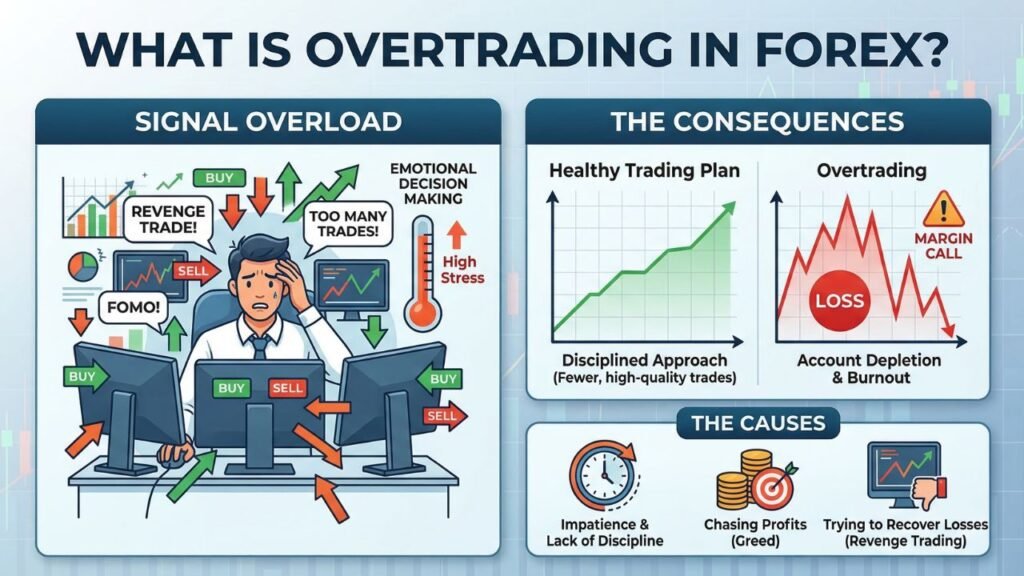
There are two main types of overtrading:
- Frequency-based overtrading: Taking too many trades in a short period. A swing trader who suddenly places 20 trades in a day has likely crossed into overtrading territory.
- Size-based overtrading: Using position sizes that are too large relative to account balance. Risking 10% per trade on a $1,000 account isn’t just aggressive, it’s overtrading through over-leveraging.
What your broker won’t tell you: every trade costs you something. Spreads, commissions, slippage—these transaction costs compound quickly when you’re churning through dozens of positions weekly.
How to Recognize the Warning Signs of Overtrading
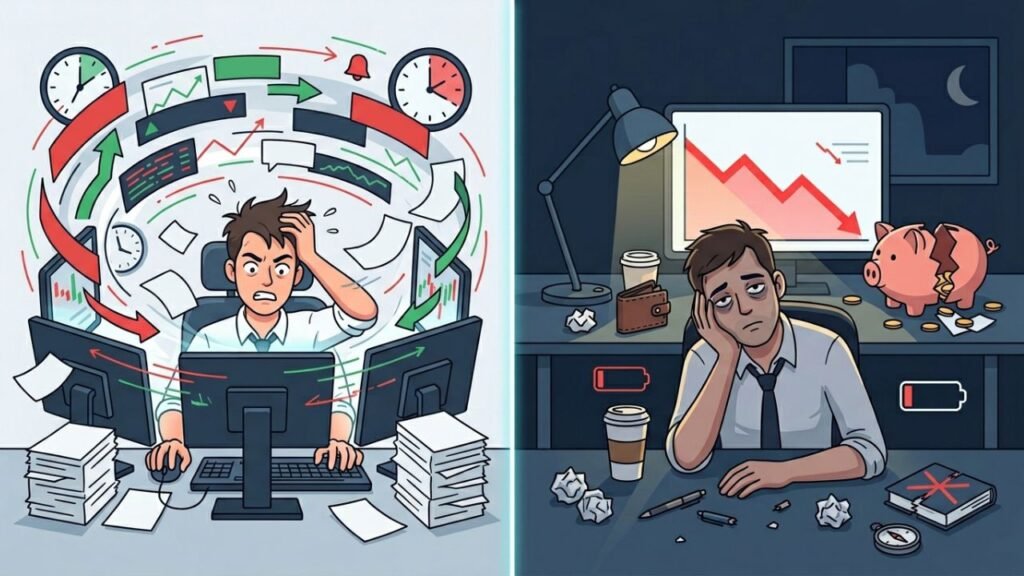
Most traders experiencing overtrading justify their behavior. “I’m just being proactive,” or “The market is giving me setups.” But the data tells a different story.
You’re likely overtrading if you notice:
- Trading Outside Your Plan You have a strategy designed for the London-New York overlap, but you’re taking setups at 2 AM because you can’t sleep. Your rules say three trades max per day, but you’ve already placed seven by noon.
- Constantly Monitoring Charts: Refreshing your MT5 platform every 30 seconds. Checking positions during dinner, family time, or work. This hypervigilance indicates emotional attachment rather than disciplined monitoring.
- Shrinking Account Despite Winning Trades You’re hitting 55% win rate—technically profitable—but your account keeps declining. Transaction costs and poor risk-reward ratios on impulsive trades are eating your edges.
- Immediate Re-Entry After Stops Your EUR/USD position hits stop loss at -50 pips. Within five minutes, you’re back in the same trade, convinced “this time it’ll work.” This is textbook revenge trading—attempting to recover losses immediately through impulsive positions.
- Unable to Explain Your Last Three Trades Ask yourself right now: why did you enter your most recent position? If the answer involves gut feeling, boredom, or “price looked good,” you’re not trading a system—you’re gambling.
Revenge Trading — The psychological pattern of placing impulsive trades immediately after a loss to quickly recover lost capital. This emotional response typically leads to larger losses and compounds poor decision-making.
The Psychology Behind Forex Overtrading

Understanding why overtrading happens is crucial to stopping it. This isn’t about discipline failures—it’s about how your brain responds to trading.
Dopamine and the Trading High
Every time you place a trade, your brain releases dopamine, the same neurotransmitter involved in gambling addiction. Winning trades create powerful positive reinforcement. But here’s the catch: even placing the trade triggers this response.
Research from Cambridge University’s Department of Psychology found that traders exhibit similar neurological patterns to individuals with gambling disorders when experiencing consecutive wins or losses. Studies on behavioral finance show the anticipation becomes addictive regardless of outcome, driven by dopamine responses in the brain’s reward system.
FOMO Trading Destroys Accounts
FOMO Trading
Fear of Missing Out trading occurs when traders enter positions not based on strategy signals, but because they fear missing a potential profitable move they see happening or anticipate might happen.
You see EUR/USD rallying 80 pips, and you weren’t in the trade. The voice in your head says, “I should be making money right now.” So you chase the move at resistance, enter with poor risk-reward, and watch it reverse.
The Forex market is open 24 hours. There will always be another trade. Missing one setup costs you nothing. Chasing that same setup recklessly can cost you 2-3% of your account.
Loss Aversion Creates Trade Loops
Behavioral economics shows humans feel losses approximately 2.5 times more intensely than equivalent gains. After a -$100 loss, traders often overtrade attempting to “break even” for the day—an arbitrary psychological target that has nothing to do with market conditions.
I’ve seen traders with solid monthly returns destroy weeks of progress in a single afternoon because they couldn’t accept being down $200 for the day.
The Illusion of Control
Overtrading often stems from feeling powerless after losses. Taking more trades creates an illusion of control—”I’m doing something about this.” In reality, you’re making reactive decisions rather than strategic ones.
Professional traders understand this: you control your process, not your results. The market does what it wants.
Real Consequences: What Overtrading Actually Costs You
Let’s run the numbers on a real scenario.
Trader A: $5,000 account, risks 1% per trade (proper risk management), averages 15 trades monthly.
Trader B: $5,000 account, risks 2% per trade, averages 60 trades monthly due to overtrading.
Both have 50% win rates and 1:1.5 risk-reward ratios. Sounds equal, right?
Trader A monthly performance:
- 15 trades: 7-8 wins, 7-8 losses
- Average spread cost: 2 pips × 15 trades = 30 pips total
- Net monthly result: +2.5% to +4%
Trader B monthly performance:
- 60 trades: 30 wins, 30 losses
- Average spread cost: 2 pips × 60 trades = 120 pips total
- Emotional trades with poor R:R: additional -3%
- Net monthly result: -1% to -3%
Same strategy. Different execution. One grows capital; the other bleeds it slowly.
And this doesn’t account for the psychological toll. Trader B is exhausted, stressed, and likely one bad week from tilting completely.
Want to ensure you’re risking the right amount per position? Use our Forex Risk Calculator to instantly determine proper position sizing based on your account balance and risk tolerance.
Common Causes of Overtrading in Forex
1. No Trading Plan or Ignoring It
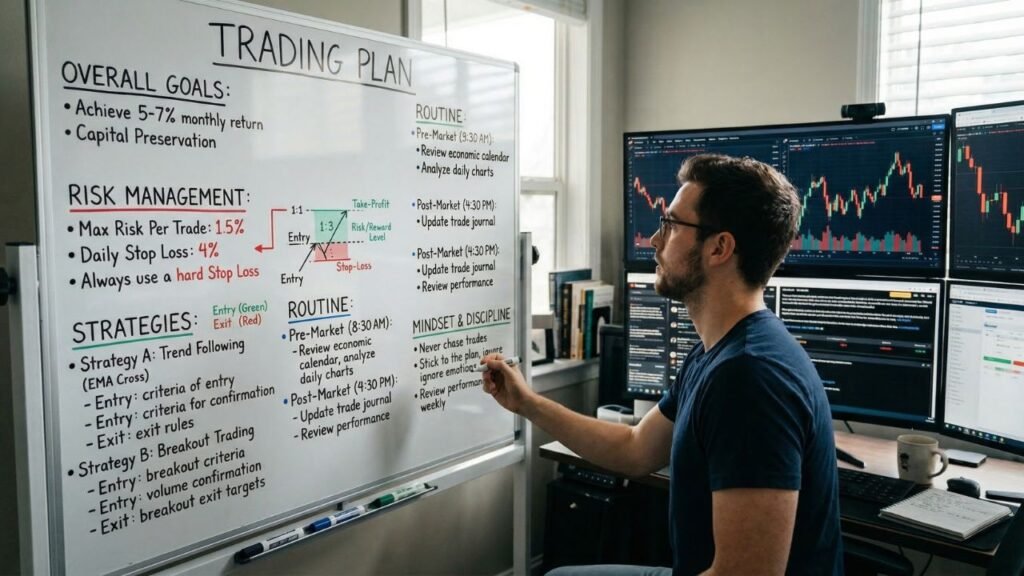
Most overtrading stems from not having clear rules or having them and abandoning them during market hours. Your trading plan should specify:
- Exact entry criteria (not “strong support,” but “third touch of daily trendline + bullish engulfing on H4”)
- Maximum trades per day/week
- Risk per trade as a percentage
- Times you’re allowed to trade
- Circumstances where you stop trading (daily loss limit)
Without these parameters, every price movement becomes a potential trade.
2. Attempting to Trade Every Market Session
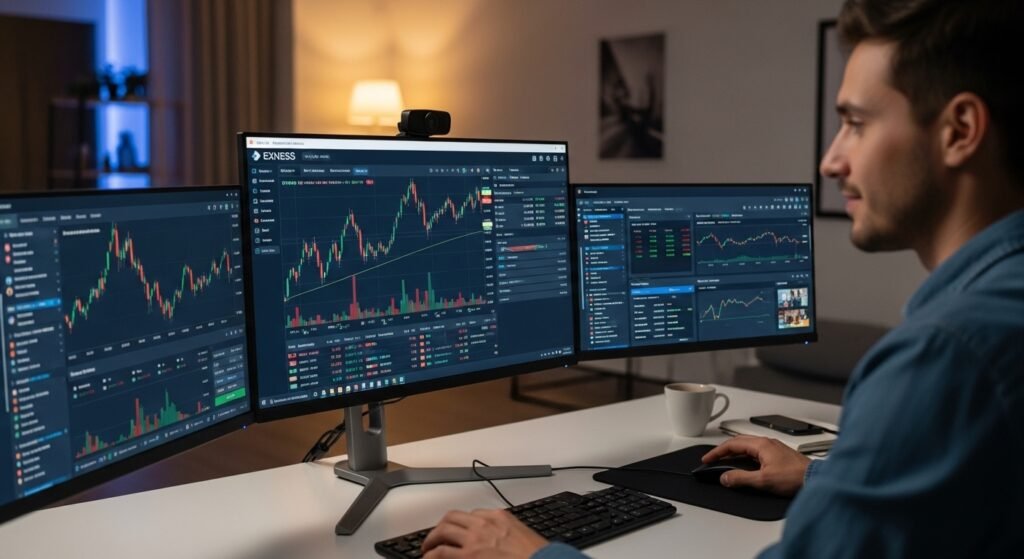
The Forex market runs 24/5, but that doesn’t mean you should be active constantly. Each session has different characteristics:
- Asian session: Lower volatility, range-bound
- London session: High liquidity, strong trends
- New York session: Volatility spikes, reversals common
If your strategy works best during London-New York overlap but you’re also taking Asian session scalps “for extra profits,” you’re overtrading.
Outside these times, don’t even open your platform. The market will be there tomorrow.
3. Using Excessive Leverage

Leverage: The ability to control a large position with a relatively small amount of capital. In Forex, leverage ratios like 1:100 mean you can control $100,000 with just a $1,000 margin.
High leverage doesn’t cause overtrading directly, but it enables it. With 1:500 leverage, a $1,000 account can open positions worth $500,000. The psychological impact is significant; small account balances can take huge positions, creating a false sense of trading success.
Regulation exists for a reason. The ESMA (European Securities and Markets Authority) caps retail Forex leverage at 1:30 for major pairs specifically because higher ratios correlate with faster account blow-ups.
4. Prop Firm Challenges Pressure
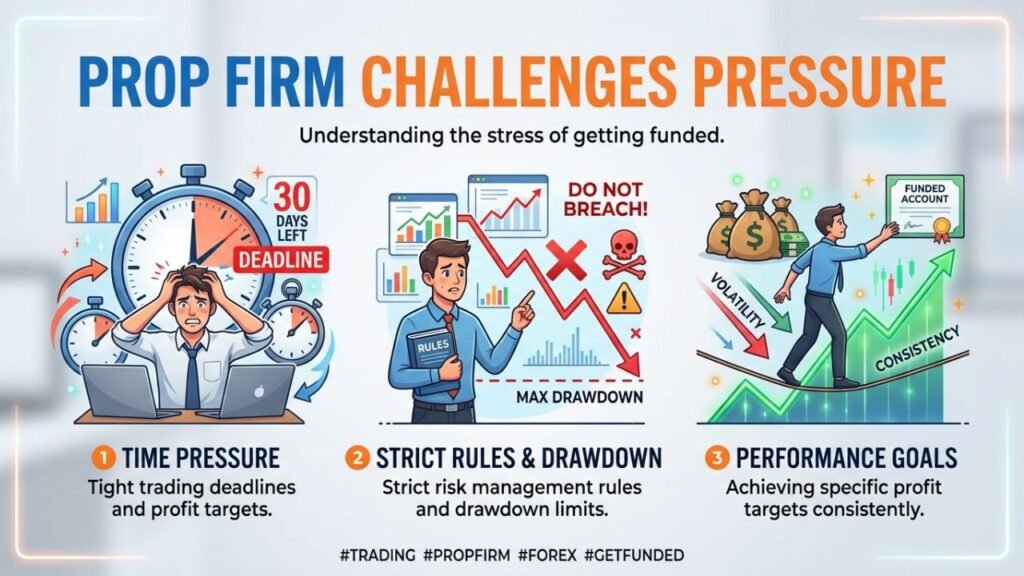
Proprietary trading firm challenges have specific profit targets and maximum loss limits within timeframes. This creates intense pressure to trade frequently to hit targets quickly.
The result? Traders abandon their strategies, overtrade, and usually fail the challenge. The firms know this—it’s profitable for them when you fail and repurchase evaluations.
If you’re in a prop challenge, stick to your strategy. The traders who pass aren’t the ones taking 50 trades to hit target—they’re the ones who take 8-12 high-quality setups.
5. Boredom and “Entertainment” Trading
Here’s an uncomfortable truth: if you’re bored watching charts, you probably shouldn’t be watching charts.
Trading isn’t entertainment. Waiting hours for a proper setup is normal. Taking a GBP/JPY scalp because “I haven’t traded in three hours and I’m bored” is overtrading in its purest form.
The best trading days often involve waiting patiently and taking one or two positions. The worst days involve constant activity that feels productive but destroys capital.
How Overtrading Differs Across Trading Styles
Understanding how overtrading manifests in different approaches helps identify your specific risks:
| Trading Style | Typical Trade Frequency | Overtrading Looks Like | Primary Risk |
|---|---|---|---|
| Scalping | 10-30+ per day | Taking setups outside peak liquidity hours, entering on every minor pullback | Death by transaction costs, spread erosion |
| Day Trading | 1-5 per day | Holding positions overnight despite strategy rules, trading during lunch lull | Strategy drift, poor risk-reward setups |
| Swing Trading | 2-8 per week | Exiting winners early to “lock in” profit and re-enter, micromanaging positions | Missing big moves, emotional exits |
| Position Trading | 1-3 per month | Adding positions without confirmation, averaging down on losers | Over-leveraging, ignoring fundamental changes |
This table shows that overtrading isn’t just about quantity; it’s about trading beyond your style’s optimal parameters.
Proven Strategies to Stop Overtrading
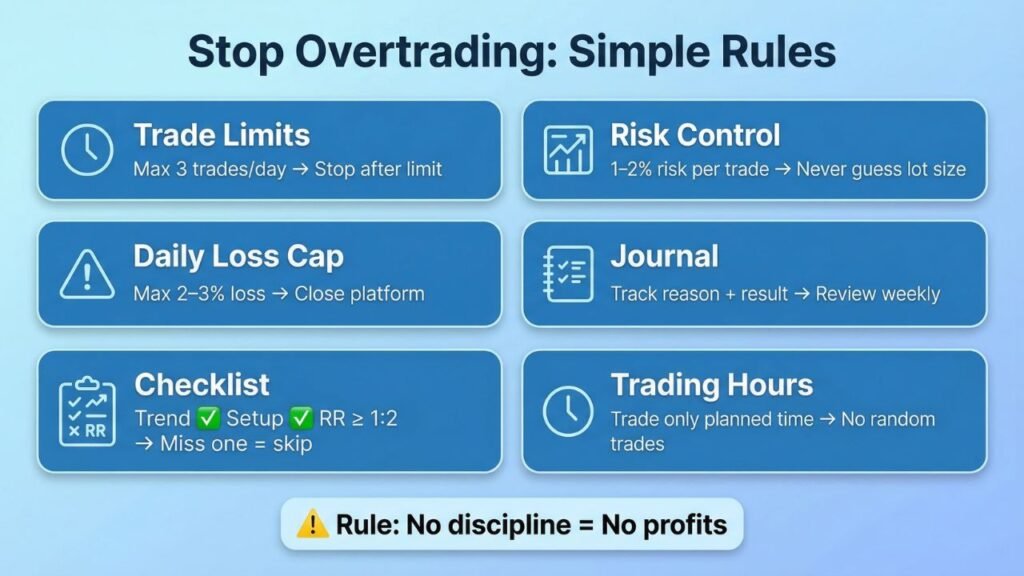
1. Implement Hard Trade Limits
Set maximum trades per day and per week. Program this into your routine:
- Scalpers: 15 trades max per day
- Day traders: 3 trades max per day
- Swing traders: 5 trades max per week
When you hit your limit, close your platform. No exceptions. Even if “the perfect setup” appears five minutes later.
Some traders use MT4 scripts that lock their accounts after X trades. The technical enforcement removes willpower from the equation.
2. Calculate Position Size Before Every Trade
Never eyeball your lot size. This single habit prevents size-based overtrading.
Example: $10,000 account, risking 1%, EUR/USD position with 40-pip stop loss.
Pip — The smallest price movement in most currency pairs. For EUR/USD, one pip equals 0.0001 or the fourth decimal place.
Manual calculation:
- Risk amount: $10,000 × 1% = $100
- Pip value needed: $100 ÷ 40 pips = $2.50 per pip
- Lot size: 0.25 standard lots (on EUR/USD, 1 standard lot = $10/pip)
Or save yourself the math, use our Lot Size Calculator to get accurate position sizing in seconds. Input your account balance, risk percentage, and stop loss distance, and it handles the calculation automatically.
3. Establish a Daily Loss Limit
If you lose a set percentage in a day, you’re done. Close everything, step away from the screens.
Common limits:
- Conservative traders: 2% daily loss = stop trading
- Moderate traders: 3% daily loss = stop trading
- Aggressive traders: 5% daily loss = stop trading
This prevents the revenge trading spiral. One bad trade becomes two, then four, then you’re down 12% trying to “fight back.”
Your job is to survive first, profit second.
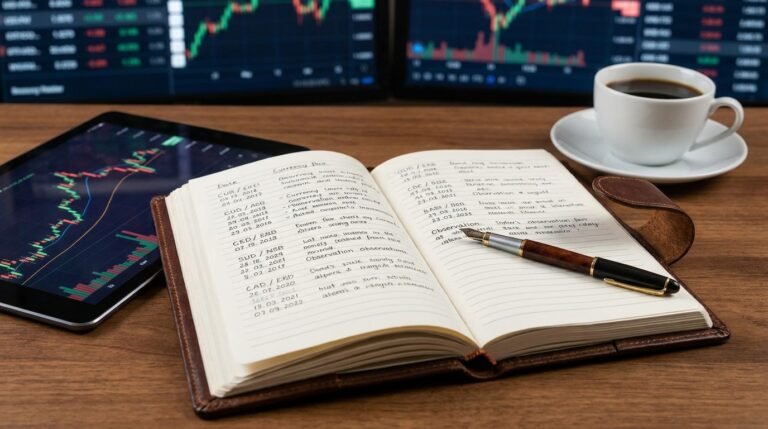
4. Keep a Trading Journal (Actually Use It)
Trading Journal: A detailed record of every trade, including entry/exit prices, position size, reasoning, emotions, and outcome. This tool identifies patterns in both winning and losing trades.
Most traders keep journals for two weeks then abandon them. The ones who maintain journals religiously have data showing exactly when they overtrade:
- Time of day (3-4 PM trades = usually impulsive)
- Day of week (Friday afternoon trades = low probability)
- After wins/losses (trades following losers = revenge trading)
Review your journal weekly. You’ll spot patterns like “every time I trade after 8 PM, I lose” or “my GBP pairs are profitable but EUR trades are break-even.”
This is objective feedback your emotions can’t argue with.
5. Create Pre-Trade Checklists
Professional pilots use checklists for every flight despite thousands of hours experience. You should too.
Sample pre-trade checklist:
- Trade aligns with daily/H4 trend direction
- Setup matches documented strategy (be specific)
- Risk-reward ratio minimum 1:2
- Position size calculated and verified
- Stop loss placement logical (not random)
- No major news in next 2 hours
- I can explain this trade in one sentence
- I’m not trying to recover from a recent loss
If you can’t check every box, don’t take the trade. This single barrier eliminates 60-70% of overtrading.
6. Schedule Trading Hours
Treat trading like a job with set hours. If your strategy works best during London session (8 AM – 12 PM GMT), those are your trading hours.
Outside these times, don’t even open your platform. The market will be there tomorrow. This removes the 24-hour temptation of Forex.
Weekend chart review is fine. Real-time monitoring at midnight when you should be sleeping? That’s how overtrading starts.
Common Mistakes Traders Make When Fighting Overtrading
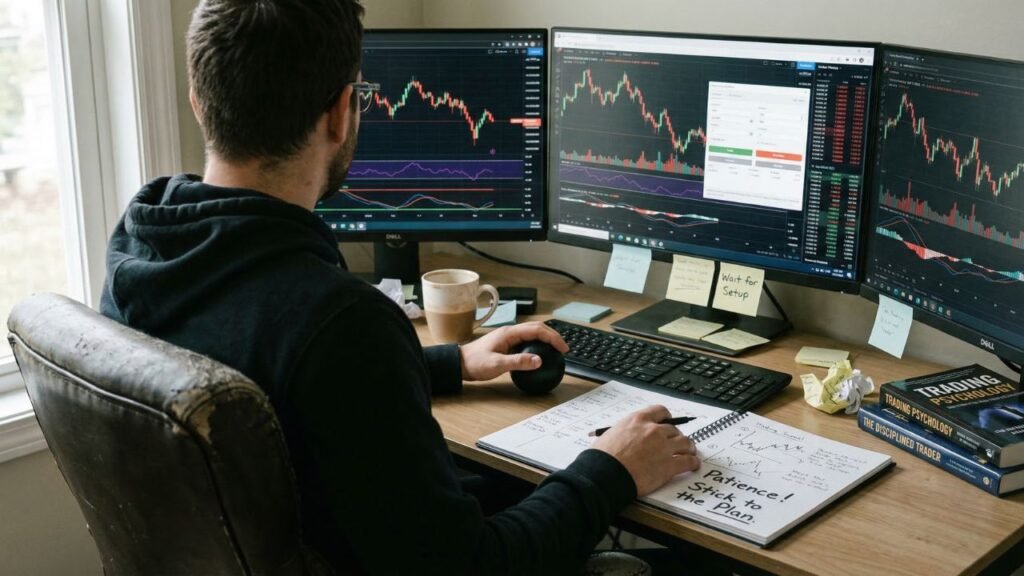
Even traders aware of overtrading make these errors when trying to fix it:
1. Going Cold Turkey Completely Some traders, after recognizing overtrading, stop trading entirely for weeks. They lose their edge and pattern recognition skills. The fix isn’t zero trades—it’s the right trades at the right frequency for your strategy.
2. Switching Strategies Constantly “Maybe if I try price action instead of indicators, I won’t overtrade.” The strategy isn’t the problem—your execution is. Switching systems every month guarantees you’ll never master anything. Commit to one approach for at least 100 trades before evaluating.
3. Blaming the Broker or Market Conditions “The spread widened so I had to take extra trades to compensate.” No. Market conditions don’t force you to overtrade—your response to them does. Widen your stops, reduce position size, or wait for better conditions. Don’t increase trade frequency.
4. Confusing Activity with Progress Taking 30 trades weekly doesn’t make you a “serious trader.” It makes you busy. Professional traders often have weeks with 3-5 total positions because they wait for high-probability setups. The scoreboard is your account balance, not your trade count.
5. Not Tracking Drawdown Properly. Many overtrading traders don’t realize how deep their drawdown actually is because they focus on individual trade P&L rather than cumulative account health.
Track your true account drawdown and recovery requirements using our Forex Drawdown Calculator. Understanding that a 20% loss requires a 25% gain just to break even changes how you view risk.
The Role of Risk Management in Preventing Overtrading
Solid risk management forex protocols don’t just protect your capital—they actively prevent overtrading by creating structure.
Fixed percentage risk per trade is non-negotiable. If you’re risking 1% per position, you can take ten consecutive losers and only be down 10%. This removes the panic that drives revenge trading.
Compare this to random position sizing: you risk $100 on one trade, $500 on the next, $250 on another. Three losses could wipe 15% of your account, triggering desperate overtrading to recover.
Stop loss management is equally critical. Traders who move stops to avoid getting stopped out are practicing a subtle form of overtrading—they’re increasing exposure beyond their original plan.
Your stop loss placement should be based on technical logic: below support, above resistance, beyond recent swing points. Not on how much you’re willing to lose emotionally.
When you respect your stops, you naturally take fewer trades because you’re waiting for setups where logical stop placement aligns with your risk parameters.
Building Long-Term Trading Discipline
Forex trading discipline isn’t built overnight. It’s the accumulation of small decisions repeated consistently.
Start with these micro-habits:
- Morning routine: Before market open, write down the three criteria your ideal trade must meet today. Review yesterday’s trades—were they plan-compliant?
- Pre-trade pause: Count to ten before placing any order. Ask: “Am I trading my strategy or my emotions right now?”
- End-of-day review: Close your platform at a set time regardless of open positions (use trailing stops). Trading isn’t a 24-hour activity—your brain needs rest.
- Weekly detox: One day per week, don’t check markets at all. This breaks the compulsive monitoring pattern.
The goal isn’t perfection. It’s a consistent improvement. If you took 40 trades last month and 30 this month, that’s progress. If your plan-compliance rate went from 60% to 75%, that’s progress.
Small gains compound.
When Overtrading Becomes Trading Addiction
There’s a line between overtrading and actual trading addiction. If you notice these signs, you may need professional help:
- Trading with money needed for bills or essentials
- Lying to family about trading losses
- Unable to stop despite consecutive losing months
- Using trading to escape problems or emotions
- Feeling restless or irritable when not trading
Trading addiction is recognized by gambling addiction specialists as a behavioral disorder. Organizations like the National Council on Problem Gambling offer resources.
This isn’t a character flaw—it’s a psychological condition that requires proper treatment. The shame keeps people suffering silently when help is available.
Tools and Resources to Combat Overtrading
Beyond discipline, specific tools make avoiding overtrading easier:
Trade management apps: Many traders use apps like Edgewonk or Tradervue that analyze journal entries and flag overtrading patterns automatically.
Platform limitations: Some brokers allow you to set daily trade limits in account settings. Once hit, the platform blocks new positions.
Accountability partners: Find another trader (Discord, forums, local meetup) who’s working on the same issue. Weekly check-ins create external accountability.
Position sizing tools: Removing the need to calculate lot size manually eliminates one excuse for impulsive trades. When you can calculate lot size instantly, you have time to evaluate if you should take the trade, not just can you.
FAQ’s
What is the main cause of overtrading in Forex?
The primary cause is emotional trading driven by fear, greed, or the need to recover losses quickly. Traders abandon their strategy rules and take positions based on impulse rather than analysis, often triggered by recent losses or boredom during slow market periods.
How many trades per day is considered overtrading?
This depends entirely on your trading style. For swing traders, even 2-3 trades daily might be excessive. Scalpers might legitimately take 15-20 trades. You’re overtrading when you exceed the frequency your tested strategy dictates, regardless of the number.
Can overtrading occur even with winning trades?
Absolutely. You can maintain a 60% win rate and still overtrade yourself into losses through transaction costs (spreads, commissions) and poor risk-reward ratios on impulsive entries. Winning percentage isn’t the same as profitability.
What’s the difference between overtrading and active trading?
Active trading follows a defined strategy with clear rules executed at high frequency. Overtrading is reactive, emotional trading without proper analysis. A scalper taking 30 planned setups is actively trading. A swing trader taking 30 random positions is overtrading.
How do I know if I’m revenge trading?
Revenge trading happens when you place trades specifically to recover recent losses, usually immediately after a stop-out. If you can’t explain your trade logic beyond “getting my money back” or you’re entering the same pair you just lost on, you’re revenge trading.
What tools help prevent overtrading?
Trading journals track patterns, lot size calculators ensure proper position sizing, and risk calculators maintain consistent exposure. Pre-trade checklists, daily loss limits, and maximum trade counters also create structural barriers against impulsive trading.
Is overtrading worse with higher leverage?
Higher leverage amplifies the consequences of overtrading but doesn’t cause it. A trader using 1:500 leverage can open dangerously large positions on impulse, making each overtrading mistake more expensive. Lower leverage forces more conservative position sizing, which can slow overtrading behavior.
Final Thoughts: Quality Over Quantity
The Forex market rewards patience and precision, not activity. Your broker loves overtraders—every spread is profit for them. Your account hates overtrading—every unnecessary trade is a leak in your capital.
I’ve watched talented traders with solid strategies destroy accounts because they couldn’t sit on their hands. The setups were there. The analysis was correct. The position sizing was calculated. But the discipline wasn’t.
Start tomorrow with this commitment: take one less trade than you think you should. If you planned three trades, take two. If you planned ten, take eight.
You’ll quickly learn that fewer, better-planned trades outperform constant activity. Your account will grow. Your stress will decrease. Your confidence in your system will build.
That’s not just better trading. That’s sustainable trading.