Risk Management Strategies for Forex Beginners Explained Simply

When I started forex trading, I blew my first account in three weeks. Not because I couldn’t read charts or didn’t understand currency pairs. I had no idea how to manage risk. No stop losses, no position sizing rules, and way too much leverage. That expensive lesson taught me what every successful trader knows: protecting your capital matters more than chasing profits.
Forex risk management isn’t about avoiding losses; that’s impossible. It’s about controlling how much you lose when you’re wrong, so you survive long enough to profit when you’re right. The forex market moves $7.5 trillion daily, and without a solid risk management plan, beginners become statistics.
This guide breaks down forex risk management for beginners into actionable strategies you can implement today, whether you’re trading EUR/USD on MT4 or just learning what a pip means.
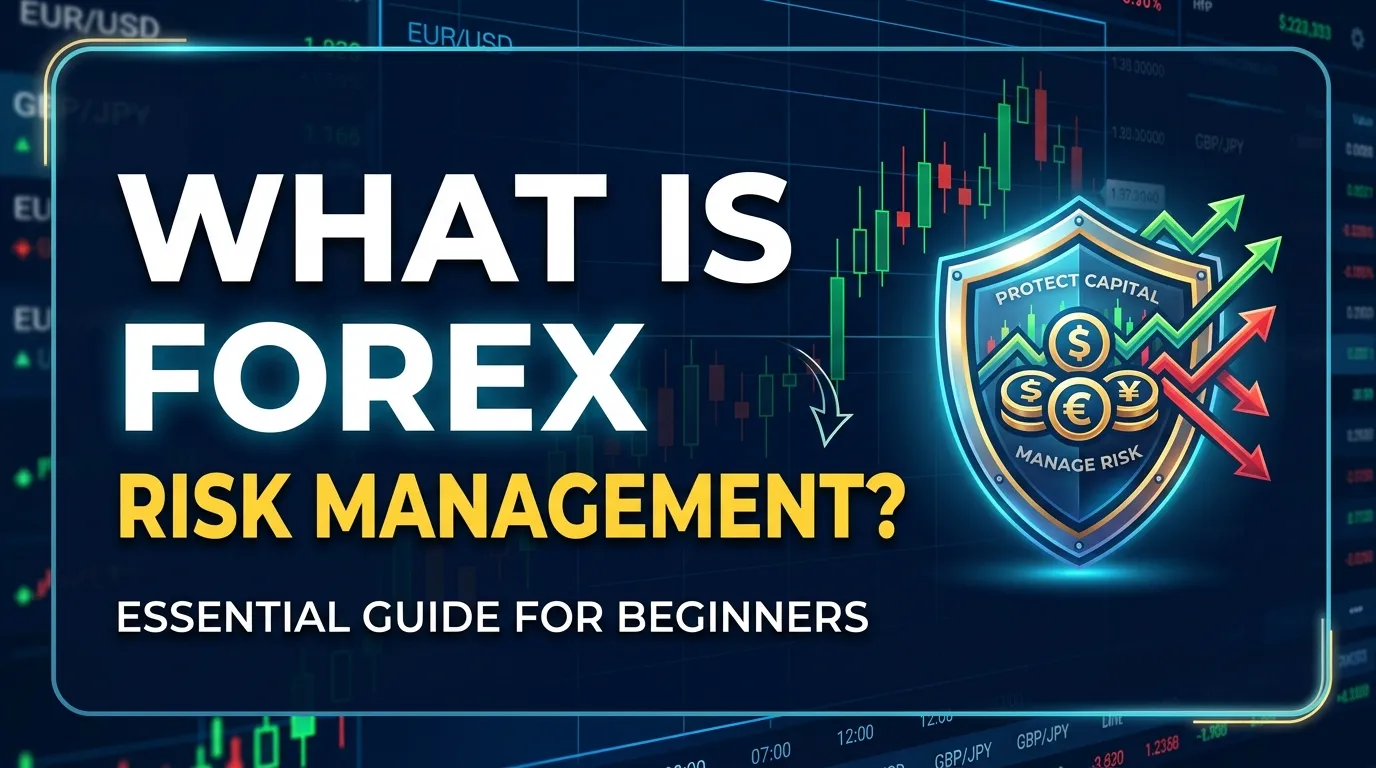
What Is Forex Risk Management?
Forex Risk Management: A set of rules that control how much money you can lose on each trade to protect your account from big losses. It combines position sizing, stop losses, leverage control, and money management to protect trading capital while allowing for profit opportunities.
At its core, forex risk management means deciding exactly how much of your trading account you’re willing to lose on each trade before you click the buy or sell button. It’s the difference between beginner forex traders who last a few months and forex traders who build sustainable, term profitability.
Why Most Beginner Forex Traders Fail at Risk Management

Here’s the uncomfortable truth: most traders don’t fail because of bad trading strategy. They fail because they don’t manage risk properly from day one.
Many traders enter the forex market with a get-rich-quick mindset. They see leverage advertised as “trade with 100x your capital!” and think it’s free money. What they don’t realize is that trading on leverage amplifies losses just as much as gains. A 1% move against a position with 100:1 leverage means a 100% account loss.
I’ve watched countless beginner traders risk 10-20% per trade, convinced that one “sure thing” trade will double their account. When that trade hits their stop loss—and it will—they’ve lost a fifth of their trading capital. After five losing trades, they’re done.
The professional approach? Risk per trade never exceeds 1-2% of total account balance. This isn’t conservative—it’s mathematical. With a 2% risk per trade, you can survive 50 consecutive losses before your account hits zero. That buffer gives you room to develop your trading skills without the pressure of revenge trading.
Core Forex Risk Management Strategies Every Beginner Needs
1. The 1-2% Rule: Your Foundation for Forex Position Sizing
The single most important risk management rule: never risk more than 1-2% of your trading account on a single trade.
Here’s what this looks like in practice:
- $500 account → Maximum risk per trade: $5-$10
- $2,000 account → Maximum risk per trade: $20-$40
- $10,000 account → Maximum risk per trade: $100-$200
This isn’t about position size in lots—it’s about potential loss. Your stop loss distance determines how many lots you can trade while staying within your risk tolerance.
Let’s say you have a $5,000 account and want to risk 1% ($50) on EUR/USD. Your trade setup has a 30-pip stop loss. You need to calculate the correct lot size so that a 30-pip move equals exactly $50.
💡 Skip the manual math — use our free Lot Calculator to get your position size in seconds based on your account balance and stop loss distance.
This is forex position sizing in action—adjusting your lot size to fit your risk limit, not the other way around. Beginners often trade a fixed 0.1 lots on every trade, ignoring the fact that a 20-pip stop on GBP/JPY risks far more than a 20-pip stop on EUR/USD due to different pip values.
2. Stop Loss Strategies: Your Trading Insurance Policy
Stop Loss — A predetermined price level where a trade automatically closes to prevent further losses. It’s the single most critical tool in any risk management system.
Never, and I mean never, enter a trade without a stop loss in place. Hope is not a strategy. The moment you think “I’ll just watch it and close manually if it goes against me” is the moment you set yourself up for disaster.
Effective stop loss placement depends on your trade setup:
- Support/resistance levels — Place stops just beyond key technical levels
- ATR-based stops — Use Average True Range to account for market volatility
- Fixed pip stops — Simple but requires proper lot sizing
- Chart pattern stops — Below swing lows for longs, above swing highs for shorts
A common beginner mistake is setting stops too tight. If you place a 10-pip stop on a volatile market conditions pair like GBP/JPY, normal market noise will stop you out before your trade has a chance to work. Give your trades room to breathe while keeping your dollar risk within your 1-2% limit.
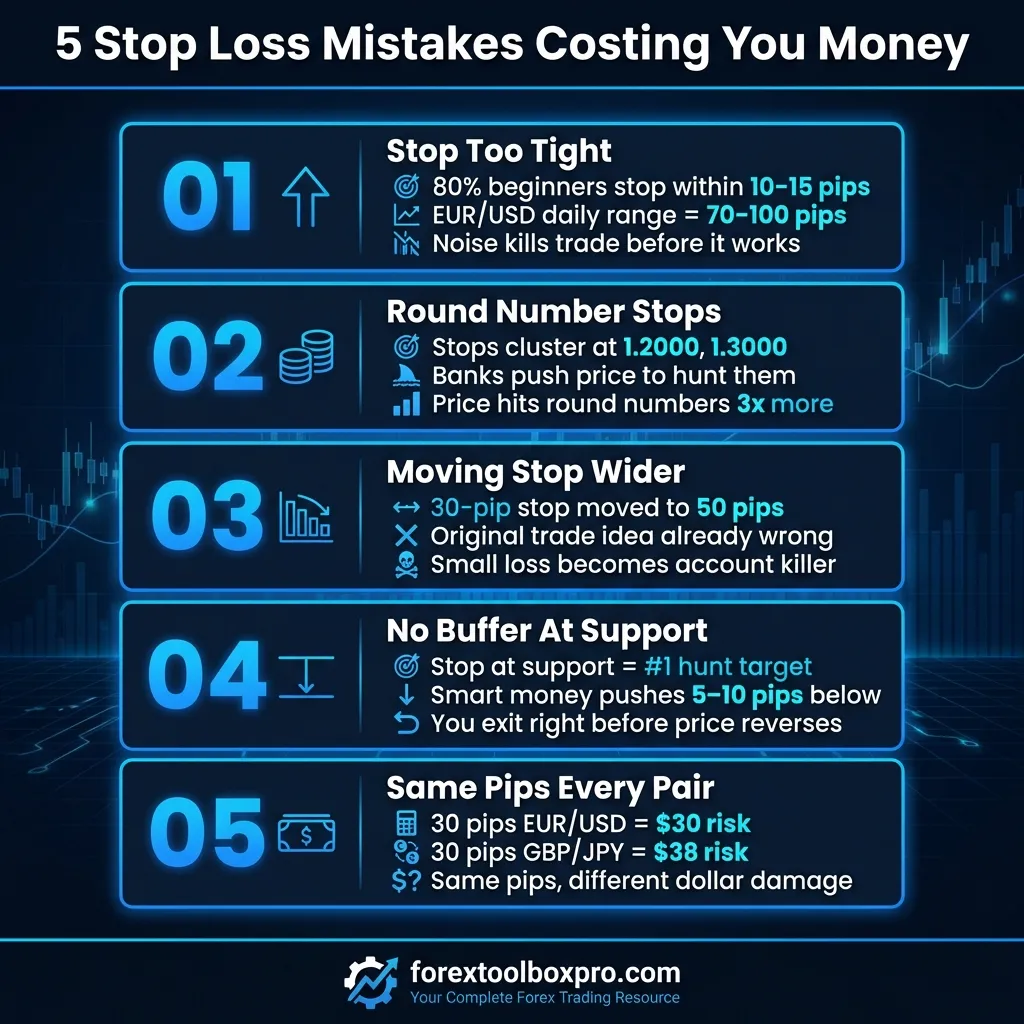
Want the trade to work? Set the stop where the trade is wrong, not where your account is comfortable. Then adjust your lot size to match your risk tolerance.
3. Leverage Control: The Double-Edged Sword
Leverage — The ability to control a large position with a small amount of capital. In Forex, brokers offer leverage ratios like 50:1, 100:1, or even 500:1, meaning you can control $50,000 with just $1,000 in margin.
Here’s what your broker won’t tell you about leverage risk: high leverage doesn’t give you more profit potential—it gives you more risk exposure.
A trader with a $1,000 account using 100:1 leverage can open a $100,000 position (1 standard lot on most currency pairs). A 100-pip move equals $1,000—their entire account. One bad trade, one missed stop loss, one unexpected central bank announcement, and they’re out.
Leverage control means using less leverage than your broker offers. Just because you can use 500:1 leverage doesn’t mean you should. Professional traders often use effective leverage of 3:1 to 10:1, regardless of what their broker provides.
Leverage Comparison by Region:
| Regulatory Body | Maximum Leverage (Major Pairs) | Maximum Leverage (Minors) | Trader Protection |
|---|---|---|---|
| CFTC (US) | 50:1 | 20:1 | Strong (FIFO, hedging rules) |
| FCA (UK) | 30:1 | 20:1 | Strong (negative balance protection) |
| ESMA (EU) | 30:1 | 20:1 | Strong (negative balance protection) |
| ASIC (Australia) | 30:1 | 20:1 | Strong (product intervention) |
| Offshore Brokers | 500:1+ | 500:1+ | Minimal to none |
Notice how regulated markets cap leverage? That’s not to limit profits—it’s to prevent beginners from destroying accounts in hours. Lower leverage forces better forex position sizing and keeps your overall risk manageable.
For more on how leverage works and its dangers, read our complete guide: What Is Leverage in Forex?
4. Risk-Reward Ratio: Making Math Work in Your Favor
📖 Risk Ratio — The relationship between potential loss (stop loss distance) and potential profit (take profit distance). A 1:2 risk-reward means you risk $1 to potentially make $2.
Even if you win only 40% of your trades, you can be profitable with the right risk ratio. Here’s the math:
10 trades, 40% win rate, 1:2 risk-reward:
- 4 winners × $200 profit = +$800
- 6 losers × $100 loss = -$600
- Net profit: +$200
Most beginner traders do the opposite—they risk $100 to make $30, then wonder why they’re unprofitable despite winning 60% of trades.
Set your take profit orders at least 2x your stop loss distance. If you’re risking 30 pips, aim for at least 60 pips profit. This gives your trading strategy mathematical edge even when you’re wrong more often than you’re right.
5. Diversification: Don’t Put All Your Margin in One Currency
This isn’t stocks—you can’t buy 50 different Forex “holdings.” But you can avoid currency risk concentration by not putting 100% of your capital into correlated trades.
If you’re long EUR/USD, EUR/GBP, and EUR/JPY simultaneously, you’re not diversified—you’re 3x long the euro. One ECB announcement goes against you, and all three trades tank together. That’s not three trades; that’s one trade with triple the risk exposure.
Smart forex traders either:
- Trade one pair at a time (maximum loss = risk per trade)
- Trade uncorrelated pairs (EUR/USD and AUD/JPY move independently)
- Limit total exposure to 3-5% of account across all open positions
Building Your Personal Forex Risk Management Plan
A good risk management plan isn’t something you copy from the internet—it’s built around your trading account size, risk tolerance, goals, and trading style.
Here’s how to build yours:
Step 1: Define Your Maximum Loss Per Trade
Start conservative. Most professionals suggest 1% for beginners. As you gain experience and prove consistency, you might increase to 2%. Never go above 2% until you have years of profitable trading and a large enough account that the dollar amount at 2% is still comfortable.
Use this simple decision tree:
- Account under $1,000? → Risk 0.5-1% max
- Account $1,000-$10,000? → Risk 1% max
- Account over $10,000? → Risk 1-2% based on experience
Step 2: Calculate Position Size for Every Trade
Never trade a fixed lot size. Your lot size should change based on:
- Your account balance (changes after each trade)
- Your risk percentage (1-2%)
- Your stop loss distance in pips
- The pip value of the currency pair you’re trading
The formula: Lot Size = (Account Balance × Risk %) ÷ (Stop Loss in Pips × Pip Value)
Step 3: Set Maximum Daily and Weekly Loss Limits
Even with perfect per-trade risk management, losing streaks happen. Set a maximum loss rule:
- Daily stop: If you lose 3% of your account in one day, stop trading until tomorrow
- Weekly stop: If you lose 5-6% in a week, stop trading until next week
This prevents revenge trading—the emotional spiral where you try to “win it back” and end up making worse decisions. Walk away, review your trading journal, and come back fresh.
Step 4: Document Everything in a Trading Journal
📖 Trading Journal — A detailed record of every trade including entry/exit prices, lot size, stop loss, take profit, reason for trade, and emotional state. It’s the most underrated tool in fx risk management.
Your trading diary should track:
- Date and time of trade
- Currency pair
- Position size (lots)
- Entry price and direction (long/short)
- Stop loss and take profit levels
- Actual risk in dollars and percentage
- Reason for entering (what was your trade setup?)
- Outcome and lessons learned
After 50-100 trades, patterns emerge. You’ll see which setups work, which pairs you trade best, what time of day you’re most profitable, and which mistakes you repeat. This data transforms you from a gambling beginner into a systematic trader.
Step 5: Create a Pre-Trade Checklist
Your good trading plan should include a checklist you review before every trade:
✅ Is my stop loss set?
✅ Have I calculated my position size based on this specific stop distance?
✅ Am I risking 1-2% or less on this trade?
✅ Is my risk-reward ratio at least 1:2?
✅ Do I have open positions on correlated pairs?
✅ What’s my maximum potential loss if all open trades hit stops?
✅ Am I trading based on my plan, or on emotion?
If any answer is “no” or uncertain, don’t take the trade.
Common Mistakes Beginners Make With Forex Risk Management
Even with the best forex risk management strategies, beginners fall into predictable traps. Here are the five most costly:
1. Risking a Fixed Lot Size Instead of a Fixed Percentage
Trading 0.1 lots on every trade feels simple, but it’s dangerous. Your account balance changes after wins and losses. A fixed lot size means your risk percentage fluctuates wildly—sometimes you’re risking 0.5%, sometimes 3%, depending on your stop distance and current balance.
Fix: Always calculate lot size based on current account balance and stop loss distance. Your risk percentage should be fixed, not your lot size.
2. Moving Stop Losses Further Away When Losing
You set a 30-pip stop. Price moves 28 pips against you. In panic, you move the stop to 50 pips “to give the trade more room.” This is how accounts die.
Your stop loss marks the point where your trade idea is wrong. Moving it further away doesn’t make the trade right—it just increases your potential loss.
Fix: Set stops when your head is clear (before entering the trade), and honor them. If you think the original stop was too tight, close the trade and re-enter with a better setup.
3. Ignoring Pip Value Differences Between Currency Pairs
A 30-pip move on EUR/USD does not equal a 30-pip move on USD/JPY in dollar terms. JPY pairs have different pip values because they’re quoted to two decimal places instead of four.
Beginner traders set the same pip stop on every pair and wonder why some trades risk twice as much as others.
Fix: Learn what is a pip in Forex for different pairs, or better yet, use a position sizing calculator that accounts for pip value automatically.
4. Using Maximum Leverage “Because It’s Available”
Your broker offers 500:1 leverage. That doesn’t mean you should use it. High leverage creates full market exposure with tiny price movements. A 20-pip adverse move with extreme leverage can trigger margin calls and forced liquidation.
Fix: Cap your effective leverage at 10:1 or lower, especially as a beginner. Focus on leverage control, not leverage maximization.
5. Trading Through News Without Adjusting Risk
Central bank decisions, NFP releases, and major economic announcements create high volatility spikes. Spreads widen, slippage increases, and your 20-pip stop might get filled at 35 pips in fast-moving markets.
Fix: Either close positions before high-impact news or reduce position size to account for increased downside risk. Never risk your standard amount during volatile market conditions.
Practical Tips for Implementing Your Forex Risk Management System
Theory means nothing without implementation. Here’s how to put these strategies into daily practice:
Start With a Demo Account
Test your risk management plan on a demo account for at least 30 days before risking real money. Track every metric:
- Win rate
- Average risk-reward ratio
- Maximum drawdown
- Consecutive losses
- Profit factor
If you can’t be profitable (or at least break-even) on demo while following strict risk rules, you’re not ready for live trading.
Use Tools to Remove Emotion From Position Sizing
Manual math fails when emotions run high. After three losing trades, you’re not in the right mindset to calculate lot sizes. Automate it.
💡 Not sure what position size to use on your next trade? Try our Risk Calculator to get precise lot sizes based on your account and risk tolerance.
Tools eliminate errors and keep you consistent even when frustrated or overconfident.
Review Your Trading Performance Weekly
Set aside one hour each week to review:
- Your trading journal entries
- Your actual vs. planned risk per trade
- Trades where you violated your rules
- Trades where you followed your rules perfectly
The goal isn’t to beat yourself up over mistakes—it’s to identify patterns and improve. After 12 weeks, you’ll have clear data on whether your trading strategy has edge and whether your risk management is working.
Adjust Risk Based on Account Growth
As your account grows, revisit your risk parameters. A trader with a $500 account risking 1% ($5) per trade faces different psychological pressure than one with a $50,000 account risking 1% ($500).
Some traders reduce their risk percentage as accounts grow because the dollar amounts become meaningful. Others scale up. There’s no universal rule—align with your risk tolerance and life situation.
Never Let Emotions Override Your Plan
You’ll have trades that would’ve been profitable if you’d just moved your stop loss. You’ll have trades that go against you immediately. You’ll have five winners in a row and feel invincible.
None of that matters. Your forex trading plan exists for a reason. The moment you start making “just this once” exceptions is the moment your money management system fails.
Emotional decisions destroy more accounts than bad trade setups ever will.
Risk Management Comparison: Conservative vs. Aggressive Approaches
Different trading styles require different risk parameters. Here’s how conservative and aggressive risk management compare:
| Factor | Conservative Approach | Moderate Approach | Aggressive Approach |
|---|---|---|---|
| Risk Per Trade | 0.5% | 1% | 2% |
| Max Leverage Used | 5:1 | 10:1 | 20:1 |
| Risk-Reward Minimum | 1:3 | 1:2 | 1:2 |
| Max Open Trades | 1-2 | 2-3 | 3-5 |
| Max Weekly Loss | 2% | 3-4% | 5-6% |
| Recommended For | Accounts under $1K, absolute beginners | Traders with 6-12 months experience | Experienced traders with proven edge |
| Survival Time (consecutive losses) | 200 trades | 100 trades | 50 trades |
There’s no “best” column here—it depends on your trading journey, account size, and how you handle losses. Most professionals stay in the moderate category regardless of experience because minimum risk that still allows growth is the optimal long-term strategy.
A conservative 0.5% risk isn’t cowardice when you’re learning—it’s strategic. It buys you time to develop skills without the pressure of rapid account depletion.
FAQ’s
What is the best risk percentage per trade for a beginner?
Risk 1% per trade if your account is over $1,000, or 0.5% if under $1,000—this gives you enough buffer to survive the learning curve.
How do I calculate lot size without a calculator?
Use this formula: Lot Size = (Account Balance × Risk %) ÷ (Stop Loss Pips × Pip Value), or just use a lot size calculator to avoid mistakes.
What happens if I use too large a lot size in Forex?
You risk blowing 10-20% of your account in one trade, triggering margin calls and making emotional decisions that destroy your trading plan.
Should I use a fixed stop loss distance or adjust it per trade?
Always adjust your stop based on the trade setup—place it where the trade idea is wrong, then size your lot to fit your 1-2% risk limit.
How much leverage should a beginner Forex trader use?
Keep effective leverage at 5:1 or lower—never use your broker’s maximum leverage (50:1, 100:1, 500:1) regardless of experience.
What’s the difference between risk management and money management in Forex?
Risk management protects against losses (stops, position sizing), while money management handles capital allocation and profit compounding—you need both.
How do I stick to my risk management plan during a losing streak?
Accept that 5-7 consecutive losses are normal, stick to your 1-2% risk per trade, and stop trading if you hit your weekly loss limit (5-6%).
Conclusion
The forex market doesn’t care about your account size, your dreams, or your “can’t lose” setup. It’s a zero-sum game where your losses fund someone else’s profits. The only edge you fully control is risk management.
Beginner forex traders who master position sizing, leverage control, and disciplined stop placement survive the first brutal year. Those who don’t become cautionary tales. The strategies in this guide aren’t theoretical—they’re the minimum requirements for long-term survival in the forex market.
Start small, risk less than you think you should, and treat every trade like a repeatable business decision, not a lottery ticket. Your trading account is your business capital—protect it like your financial life depends on it, because it does.
Remember: The best traders aren’t the ones who make the most per trade—they’re the ones still trading five years from now.