FOMO in Forex Trading: How to Beat It

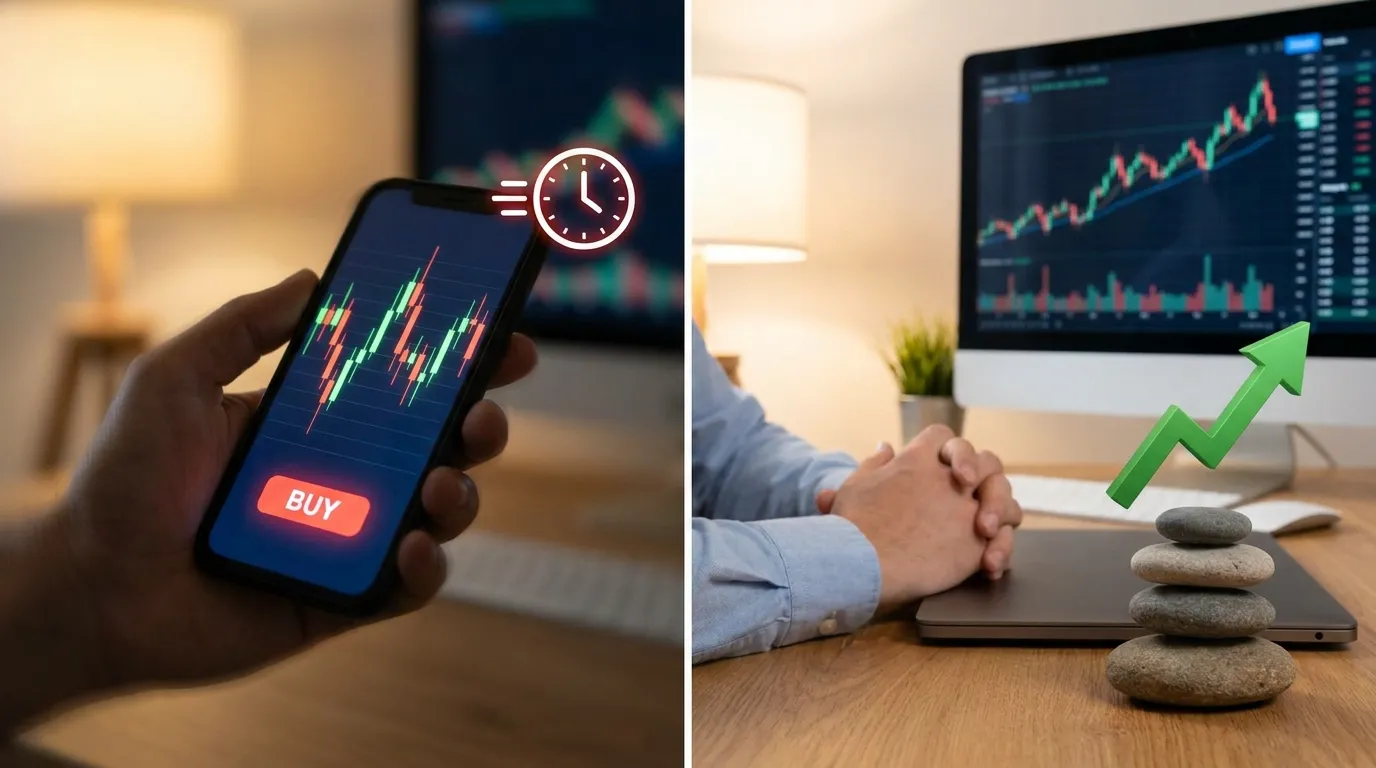
Your alert goes off. EUR/USD just ripped 80 pips in twenty minutes and you weren’t in it. Your chest tightens. Your thumb hovers over the buy button. You didn’t check your plan, you didn’t check your risk, you just didn’t want to miss it.
That reaction has a name: FOMO, the fear of missing out. In forex, it’s one of the quiet account killers, because it doesn’t feel reckless in the moment. It feels like opportunity.
This guide breaks down what FOMO actually is, why it hijacks otherwise rational traders, and seven concrete habits that help you trade the chart in front of you instead of the one you missed.
1. What Is FOMO in Forex Trading?
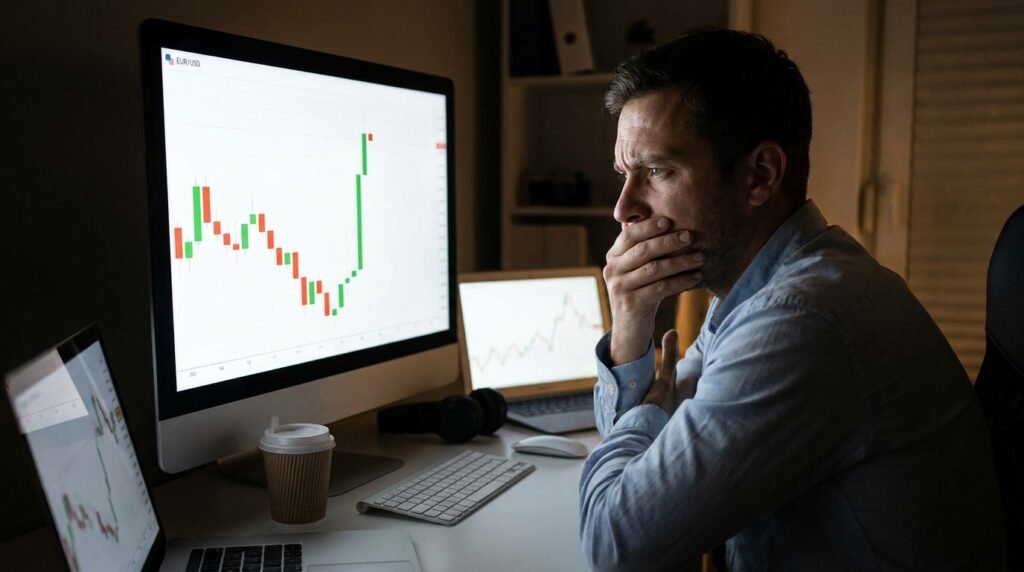
FOMO in forex is the urge to enter a trade mainly because a price has already moved, not because your setup or your plan called for it. It’s the emotional urge to enter a trade or investment primarily because others appear to be profiting, rather than because it aligns with a clear strategy.
The term predates trading entirely. In the context of financial markets, FOMO refers to the fear a trader feels about missing out on a potentially lucrative opportunity, a feeling that becomes especially strong when an asset has already risen sharply in a short window.
In forex specifically, this usually shows up as:
- Jumping into a pair mid-breakout with no entry plan
- Doubling a normal position size because “this one feels different”
- Abandoning your stop loss because the move is “too good to cut short”
- Switching strategies mid-week because someone else’s trade idea looked easier
None of this is a character flaw. It’s a predictable response to how markets present information, and understanding the mechanism is the first step to managing it.
2. Why Your Brain Is Wired to Chase the Market
FOMO isn’t unique to forex, and it isn’t unique to trading. Behavioral finance groups FOMO alongside herd mentality, anchoring, and loss aversion as core biases that drive investor behavior away from logic and toward emotion.
Two forces make it especially strong in fast-moving markets like forex:
Scarcity framing. FOMO is categorized in behavioral finance as a form of scarcity bias, where an exaggerated emphasis gets placed on the limited availability of an opportunity rather than its actual underlying value. A currency pair spiking on a news release looks scarce and urgent, even when the underlying fundamentals haven’t changed at all.
Compressed decision time. FOMO doesn’t just make you want to act. It changes how you think while acting. It replaces analysis with urgency, so instead of weighing risk you’re weighing regret.
Research on FOMO’s market-wide effect backs this up at scale. One recent study found that a 10% increase in a measured FOMO index correlated with a 1.7% to 2.0% decline in monthly returns, as investors chased speculative gains and ignored fundamentals. That’s not a small effect. It’s a repeatable pattern across an entire market of people making the exact decision you’re tempted to make right now.
Academic work on individual investors finds a similar thread. Investors under the influence of FOMO are more likely to overlook the risks tied to an investment and instead focus almost entirely on the potential upside, prioritizing short-term impulses over long-term planning. Retail forex, with its leverage and 24-hour price feed, gives that impulse a lot more room to do damage than a slower-moving asset would.
3. Common FOMO Triggers Every Trader Should Recognize
FOMO rarely appears out of nowhere. It usually follows a specific trigger. Watch for these:
Chasing a Breakout Already in Motion
The pair has already moved well past your normal entry zone, and you buy anyway because “it’s still going.”
Social Media and Trading Forums
Screenshots of someone else’s winning trade create instant comparison. If a stranger online caught the move, staying out starts to feel like a mistake, even when you had no valid setup.
Watching a Missed Trade “Prove You Right”
You saw the setup, hesitated, and the market ran without you. The next similar-looking setup gets an oversized, under-planned entry because you don’t want to miss twice.
News and Economic Releases
A surprise NFP print or rate decision sends a pair flying. The volatility itself becomes the reason to enter, not the underlying analysis.
A String of Recent Wins
Confidence from a winning streak can curdle into overconfidence, making every fast move look like free money instead of a risk you haven’t assessed.
Recognizing which of these is pulling at you in the moment is often enough to break the automatic reaction and force a pause.
4. The Real Cost of FOMO: A Worked Example
Numbers make this easier to feel than a warning alone.
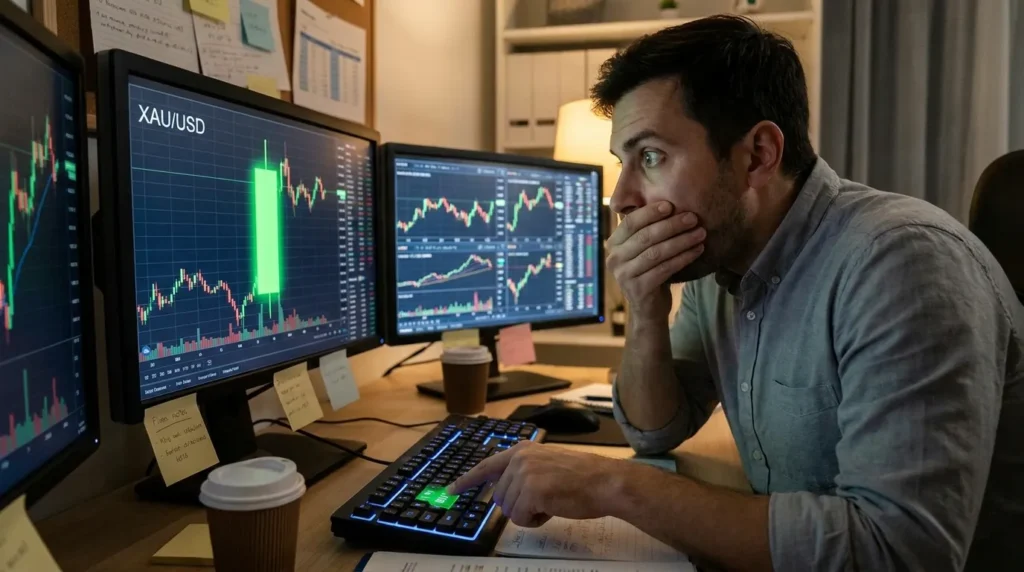
Say a trader with a $2,000 account normally risks 1% per trade, or $20. A FOMO entry on a headline spike often skips the stop loss calculation entirely and instead uses a “gut feel” lot size, say 0.10 lots on EUR/USD instead of a properly sized 0.04 lots for the same $20 risk.
If the reversal comes even 25 pips against the position, at 0.10 lots that’s roughly a $25 loss instead of the $20 the trader’s own risk rule allowed. Not catastrophic on its own. But FOMO entries rarely happen once. They compound across a week of chasing, and the account bleeds through a pattern of small, oversized, unplanned losses rather than one dramatic blowup.
This is exactly why sizing every trade through a Lot Size Calculator or a Forex Risk Calculator before entry matters more in high-emotion moments than in calm ones. The math doesn’t get swept up in the urgency the way you can.
5. FOMO vs. Revenge Trading vs. Overtrading
These three psychological patterns often get lumped together, but they start from different emotional triggers.
| Pattern | Trigger | Typical Timing | Core Emotion |
|---|---|---|---|
| FOMO | A move already happening without you | Mid-trend, mid-breakout | Fear of missing gains |
| Revenge Trading | A recent loss | Immediately after a losing trade | Urge to “win back” money |
| Overtrading | Boredom, dopamine, or habit | Any time, often no trigger at all | Compulsion to act |
They frequently feed each other. A FOMO entry that goes wrong can trigger a revenge trade, which then spirals into a session of overtrading. If you recognize any one of these patterns in your own history, it’s worth reading the related breakdowns on overtrading in forex and revenge trading, since the fixes overlap heavily with what’s below.
6. 7 Practical Ways to Beat FOMO
1. Write Entry Rules You Can’t Argue With in the Moment
A trading plan only works if it removes discretion during high emotion. Define your setup criteria in writing, ahead of time, so there’s no debate to have when a candle is moving fast.
2. Use Price Alerts Instead of Watching Charts All Day
Constant chart-watching manufactures FOMO by exposing you to every micro-move. Set alerts at your planned levels and step away between them. If you didn’t see the move happen live, it’s much easier to let it go.
3. Size Every Trade With a Calculator, Not a Feeling
Before entering, run the trade through a Forex Risk Calculator or Pip Value Calculator. If the position size that comes out feels smaller than what your gut wants to enter with, that gap is worth noticing.
4. Set a Hard Rule: No Entries Mid-Move
Decide in advance that you only enter at a planned level, on a pullback, or on a confirmed retest, never mid-spike. This single rule eliminates most FOMO entries before they happen.
5. Journal the Trade You Didn’t Take
When you skip a move, write down why, and check back later whether skipping it was actually the wrong call. Most traders find that the missed trades they agonized over were mediocre setups in hindsight, not the disasters FOMO made them feel like in the moment.
6. Know Your Risk-Reward Before You Ever See the Move
Traders who’ve already defined their risk-reward ratio for a strategy have a built-in filter. If a FOMO setup doesn’t meet that ratio, the decision is already made.
7. Track Drawdown, Not Just Wins
A string of FOMO trades often looks fine day to day until a drawdown calculator shows the account is down further than any single loss would suggest. Reviewing this weekly makes the cumulative cost of chasing visible instead of hidden.
7. Building a FOMO-Proof Trading Routine
Beating FOMO isn’t a one-time fix, it’s a routine. A few structural habits help most:
Trade fewer sessions, deliberately. Knowing the forex trading sessions that fit your strategy means you’re not glued to the chart 24 hours a day waiting for something to happen. Less exposure to noise means fewer chances for FOMO to trigger.
Pre-decide your risk per trade. Reviewing how much you should risk per trade once, calmly, is far more reliable than deciding it fresh in the middle of a fast move.
Build a pre-trade checklist. Before any entry: Does this match my written setup? Have I sized it with a calculator? Is my stop loss placed before I click buy or sell? If any answer is no, the trade waits.
Review, don’t just trade. A short weekly review of entries, especially the ones made in a rush, turns FOMO from an invisible pattern into a trackable, correctable one.
Frequently Asked Questions
Is FOMO trading the same as impulsive trading?
They overlap heavily. FOMO is a specific type of impulsive trading driven by watching an opportunity move without you, while impulsive trading can also come from boredom, anger, or overconfidence unrelated to a specific missed move.
Does FOMO affect experienced traders too?
Yes. Experience tends to reduce how often FOMO leads to a bad entry, but it doesn’t remove the emotional pull itself. Even professional traders build rules specifically because they know the temptation doesn’t disappear with skill.
Can FOMO ever lead to a good trade?
Occasionally a FOMO entry works out, but a lucky outcome doesn’t validate the process. The danger is that one profitable FOMO trade reinforces the habit, making the next one, which likely won’t work, more probable.
How do I know if a trade is FOMO or a legitimate late entry?
Ask whether the trade still meets your written setup criteria at current price, with a normal stop and normal size. If it only makes sense because “it’s already moving,” that’s FOMO, not a legitimate signal.
Why does FOMO feel stronger in forex than in other markets?
Forex trades nearly 24 hours a day with high leverage available to retail accounts, which means there’s almost always a fast move happening somewhere and more capital exposure per trade than many other markets. That combination amplifies the urgency FOMO creates.
Does social media make FOMO worse?
Generally, yes. Seeing other traders’ wins in real time, without seeing their losses or their process, creates a skewed picture of how achievable those gains actually were, which intensifies the pressure to chase.
What’s the single fastest way to reduce FOMO trades?
Pre-calculating position size and stop loss before you ever look at a live chart. Most FOMO entries happen because sizing and risk get decided in the heat of the moment instead of in advance.
Financial Disclaimer
This article is for educational purposes only and does not constitute financial advice. Forex trading, particularly with leverage, involves substantial risk of loss and is not suitable for all investors. In the United States, retail forex leverage is capped by the CFTC and NFA at 50:1 on major currency pairs and 20:1 on minor pairs. These limits are designed to reduce the potential for significant losses tied to margin trading. Always consult a licensed financial advisor before making trading decisions.
Conclusion
FOMO doesn’t show up as a warning sign, it shows up as a candle you didn’t want to miss. The traders who manage it best don’t claim to feel it less. They’ve simply built rules, calculators, and checklists that make the decision before the emotion arrives, not during it.
Start with one change: run your next trade through the Forex Risk Calculator before you enter, not after. If the size it gives you feels too small for how the move feels, that gap is exactly what FOMO looks like from the outside.