How Much Should You Risk Per Trade?

Risk management is the foundation of long-term trading success, yet it’s something many traders overlook. Instead of focusing on protecting their capital, they chase the “perfect” entry or the latest market signal. The reality is that what separates professional traders from amateurs isn’t just their winning trades—it’s their ability to control how much they risk on each trade and survive losing streaks.
Even a strong trading strategy can’t save you from large losses if your position size is too big. A few bad trades can undo months of progress and hurt your confidence. That’s why experienced traders use tools like a risk calculator to plan position sizes, set stop losses, and estimate potential drawdowns before committing real money. Learning to manage risk effectively isn’t just smart—it’s essential for consistent profits and long-term success.
How Much Should you risk per trade?
The answer determines your maximum loss, your ability to survive losing streaks, and whether you stay in the game long term.
In this guide, you’ll learn:
- What the 1% rule really means
- How to calculate proper position size
- How losing streaks affect your account balance
- The mathematics of maximum drawdown
- How to reduce risk of ruin
- Practical examples in forex, stocks, and crypto
This is not theory. This is capital preservation strategy.
Why Risk Management Matters More Than Winning

Every trading strategy experiences losing trades. Even hedge funds, prop firms, and institutional desks go through drawdowns. The difference is that professionals manage risk before thinking about reward.
If you risk too much:
- A short losing streak can wipe out months of gains
- Your account balance shrinks rapidly
- Recovery becomes mathematically harder
- Emotions take control
If you control risk:
- Losses stay small
- Drawdowns remain manageable
- You protect long-term growth
- You stay psychologically stable
Trading success is not about being right; it’s about managing risk intelligently.
The 1% Rule Explained
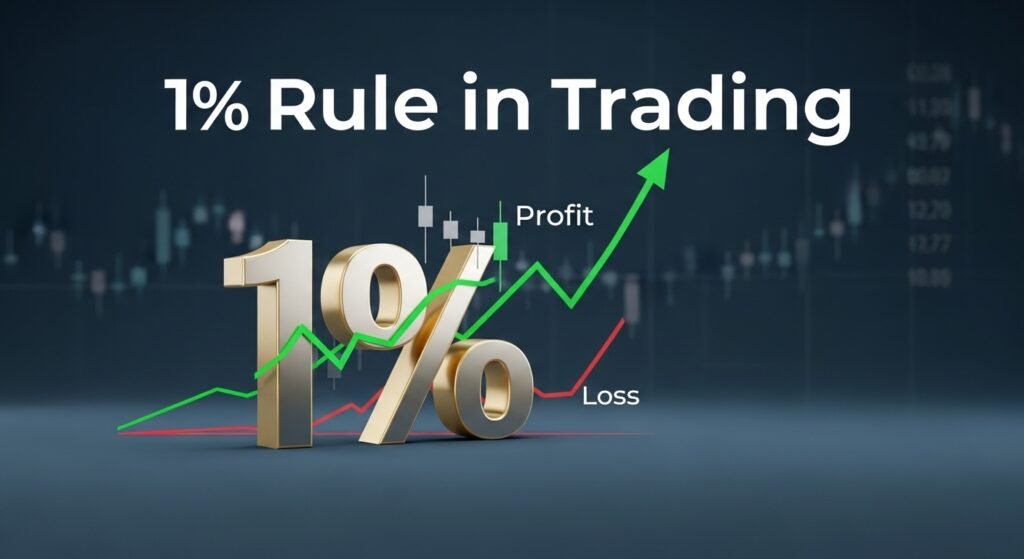
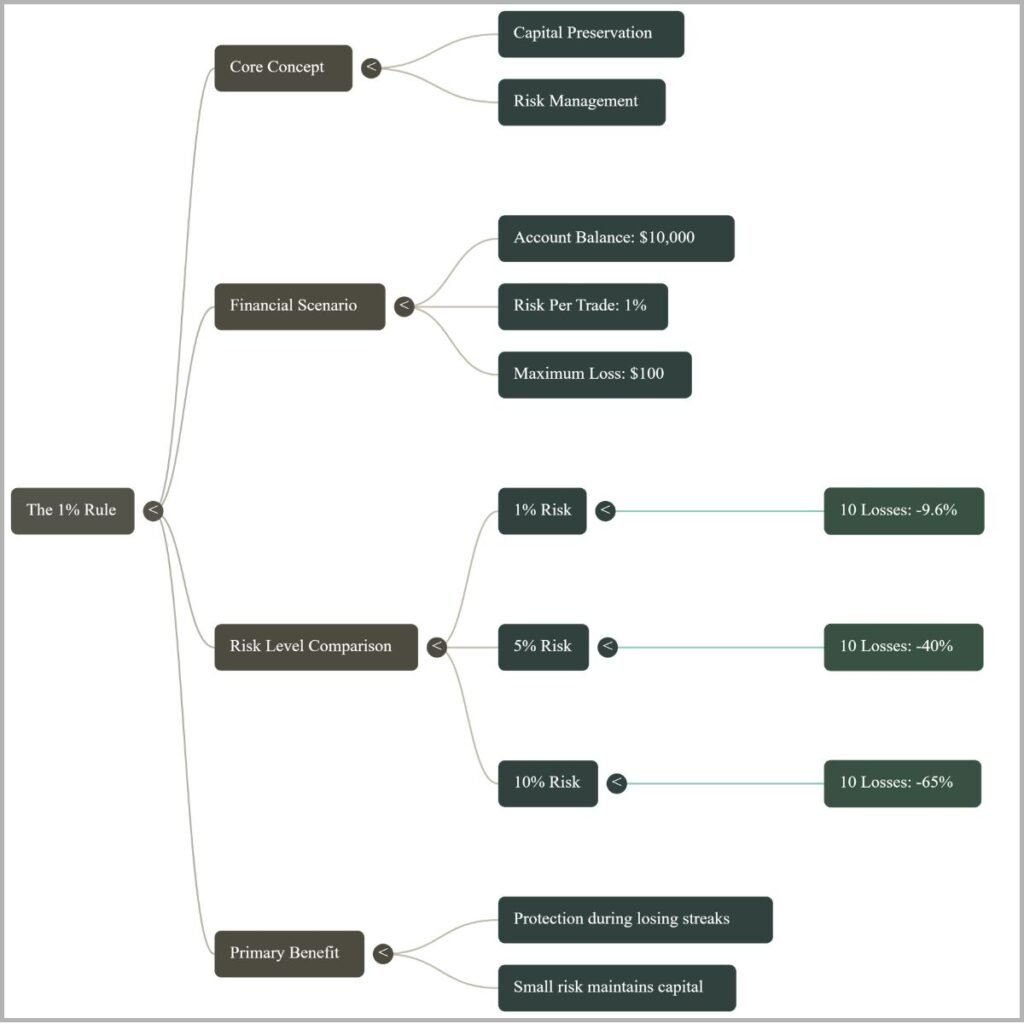
The 1% rule means:
Never risk more than 1% of your total account balance on a single trade.
If your account balance is $10,000:
Maximum loss per trade = $10,000 × 1% = $100
If your stop loss is triggered, you lose $100, not $500 or $1,000. This approach protects you during:
- Losing streaks
- High volatility
- Emotional trading phases
- Market uncertainty
Why the 1% Rule Works Long Term
Consider compounding math.
If you lose 10 trades in a row at 1% risk, your account declines about 9.6%. Painful, but manageable.
Now imagine risking 10% per trade. Ten consecutive losses would reduce your account by roughly 65%. That kind of drawdown destroys confidence and makes recovery extremely difficult.
The 1% rule reduces the risk of ruin, keeping you alive long enough for your edge to play out.
The Mathematics of Risk Per Trade and Losing Streaks
Every strategy has variance. Even a system with a 55% win rate can experience multiple losing trades in a row. The key is how much damage each loss causes.
Here’s how different risk levels affect your account during consecutive losses:
| Risk Per Trade | 5 Losses | 10 Losses | 20 Losses |
|---|---|---|---|
| 1% | -4.9% | -9.6% | -18.2% |
| 2% | -9.6% | -18.3% | -33.2% |
| 5% | -22.6% | -40.1% | -64.1% |
| 10% | -41% | -65% | -88% |
Notice how compounding accelerates losses as risk increases. Higher risk per trade dramatically increases maximum drawdown and probability of ruin.
If you want to simulate different scenarios, you can use our Forex Drawdown Calculator to test how various losing streaks impact your account balance over time. This is how professionals think — in probabilities, not emotions.
Maximum Drawdown and Recovery Reality
Drawdown recovery is not linear. The larger the loss, the harder the recovery becomes.
Here’s the mathematical reality:
| Drawdown | Required Gain to Recover |
|---|---|
| 10% | 11.1% |
| 20% | 25% |
| 30% | 42.8% |
| 50% | 100% |
| 70% | 233% |
If you lose 50% of your account balance, you must generate a 100% return just to break even.
The deeper the drawdown, the more pressure you place on future trades. Controlling maximum loss per trade is critical for survival and consistent profits.
How to Calculate Risk Per Trade (Professional Formula)
The correct formula for position sizing is:
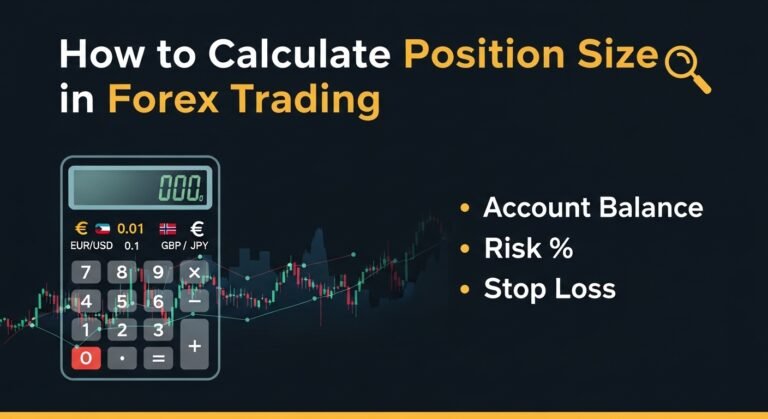
Position Size = (Account Balance × Risk %) ÷ Stop Loss Distance
This ensures your maximum loss remains controlled.
Let’s apply it to real markets.
Forex Example
Account balance: $5,000
Risk per trade: 1%
Maximum loss allowed: $50
Stop loss: 25 pips
Step 1: $5,000 × 1% = $50
Step 2: $50 ÷ 25 pips = $2 per pip
Since a standard lot equals $10 per pip, you would trade 0.20 lots.
If you want to automate this, try our Lot Size Calculator to instantly calculate position size. For a deeper breakdown of position sizing, read How to Calculate Lot Size in Forex.
If you’re unsure about pip valuation across currency pairs, the Pip Value Calculator can help determine exact pip value.
Stock Market Example
Account balance: $20,000
Risk per trade: 1% = $200
Stock entry: $100
Stop loss: $95
Risk per share = $5
Position size = $200 ÷ $5 = 40 shares
This keeps your maximum loss fixed at $200 and protects your account from large drawdowns.
Crypto Example
Account balance: $8,000
Risk per trade: 1% = $80
Entry: $40,000
Stop loss: $39,200
Risk per coin = $800
Position size = $80 ÷ $800 = 0.1 BTC
Risk of Ruin: The Hidden Account Killer

Risk of ruin measures the probability of losing your entire account.
It depends on:
- Risk per trade
- Win rate
- Risk-reward ratio
- Losing streak probability
Even profitable systems fail when position sizing is too aggressive.
A trader risking 5% per trade may experience:
- Large account swings
- Emotional instability
- Compounding drawdowns
- Capital depletion
Lower risk dramatically reduces probability of total failure. Professionals prioritize survival first.
Risk vs Reward: Expectancy Matters
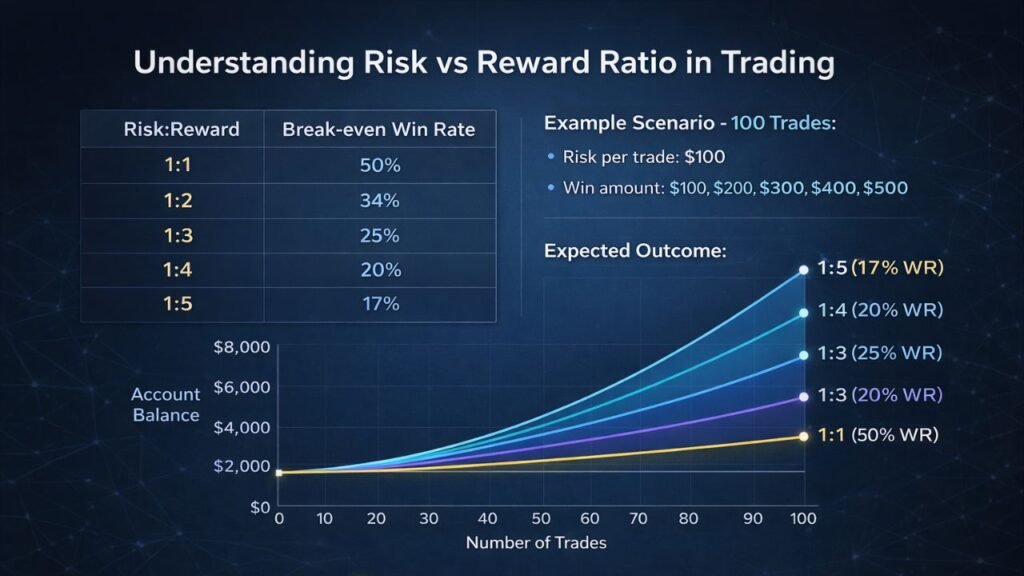
Risk control alone is not enough. You need positive expectancy.
Expectancy formula:
(Win Rate × Average Win) − (Loss Rate × Average Loss)
Example:
- Win rate: 45%
- Risk-reward ratio: 1:2
- Risk per trade: 1%
Even with frequent losing trades, this system can generate consistent profits over time. Smart traders balance risk management with reward potential.
How to Manage Risk During a Losing Streak
Losing streaks are statistically inevitable. Professionals respond strategically:
- Reduce risk temporarily
- Review trade journal
- Avoid increasing position size
- Never widen stop loss emotionally
Revenge trading increases maximum loss and accelerates drawdown. Discipline preserves capital.
Comparing Trader Risk Profiles
| Trader Type | Risk Per Trade | Long-Term Outcome |
|---|---|---|
| Gambler | 5%–20% | Account blowups |
| Emotional Trader | 3%–5% | Large drawdowns |
| Disciplined Trader | 1%–2% | Sustainable growth |
| Institutional Risk Model | 0.25%–1% | Capital preservation |
Professional traders prioritize capital preservation first. Growth comes second.
Psychological Benefits of Lower Risk
Risking 1% does more than protect capital. It stabilizes emotions.
When losses are small:
- You avoid panic
- You avoid impulsive decisions
- You follow your trading plan
- You think long term
Emotional control directly improves performance consistency.
When Should You Adjust Risk?
Reduce risk when:
- Market volatility increases
- You are in a 10%+ drawdown
- Your strategy underperforms
Increase risk only after:
- Documented consistent profits
- Stable equity curve
- Verified statistical edge
Risk must be earned, not assumed.
Practical Risk Management Checklist
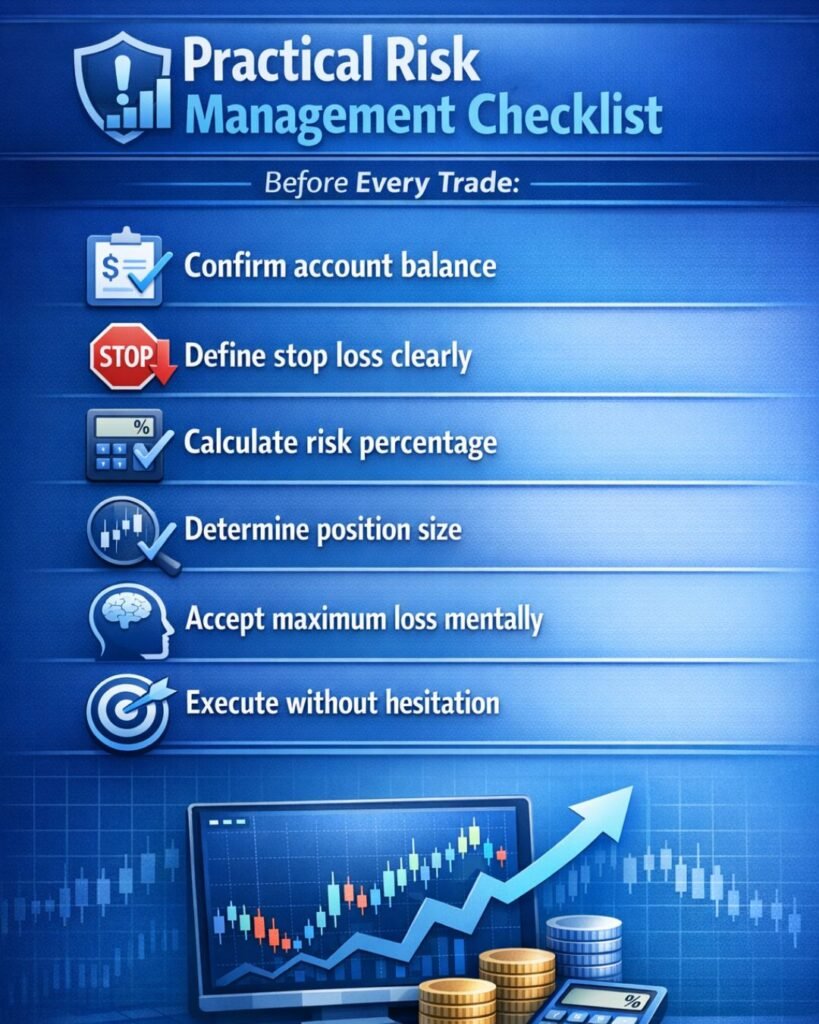
Before every trade:
- Confirm account balance
- Define stop loss clearly
- Calculate risk percentage
- Determine position size
- Accept maximum loss mentally
- Execute without hesitation
This structured process eliminates emotional trading.
Frequently Asked Questions
How much should you risk per trade as a beginner?
1% or less. Your primary goal is survival and skill development.
Is 2% risk acceptable?
Yes for experienced traders, but it increases volatility and drawdown exposure.
What happens if I risk 5% per trade?
A moderate losing streak can reduce your account balance significantly and increase risk of ruin.
Does the 1% rule apply to crypto and stocks?
Yes. The principle of fixed percentage risk applies across all markets.
Final Thoughts
Trading success is not built on aggressive risk. It is built on disciplined risk control.
Protecting your account balance allows you to refine your strategy, improve execution, and let probabilities work in your favor. Small, controlled losses are part of the process. Large, uncontrolled losses destroy trading careers.
The 1% rule is strategic, not conservative. Limiting your maximum loss per trade reduces emotional pressure, survives losing streaks, and preserves long-term compounding.
Professional traders think like risk managers. They understand survival comes first. Once survival is secured, consistent profits follow.
Protect your capital. Manage risk intelligently. Think long term. That is how smart traders stay in the game — and thrive over time.