How to Calculate Position Size in Forex Trading for Beginners Step by Step

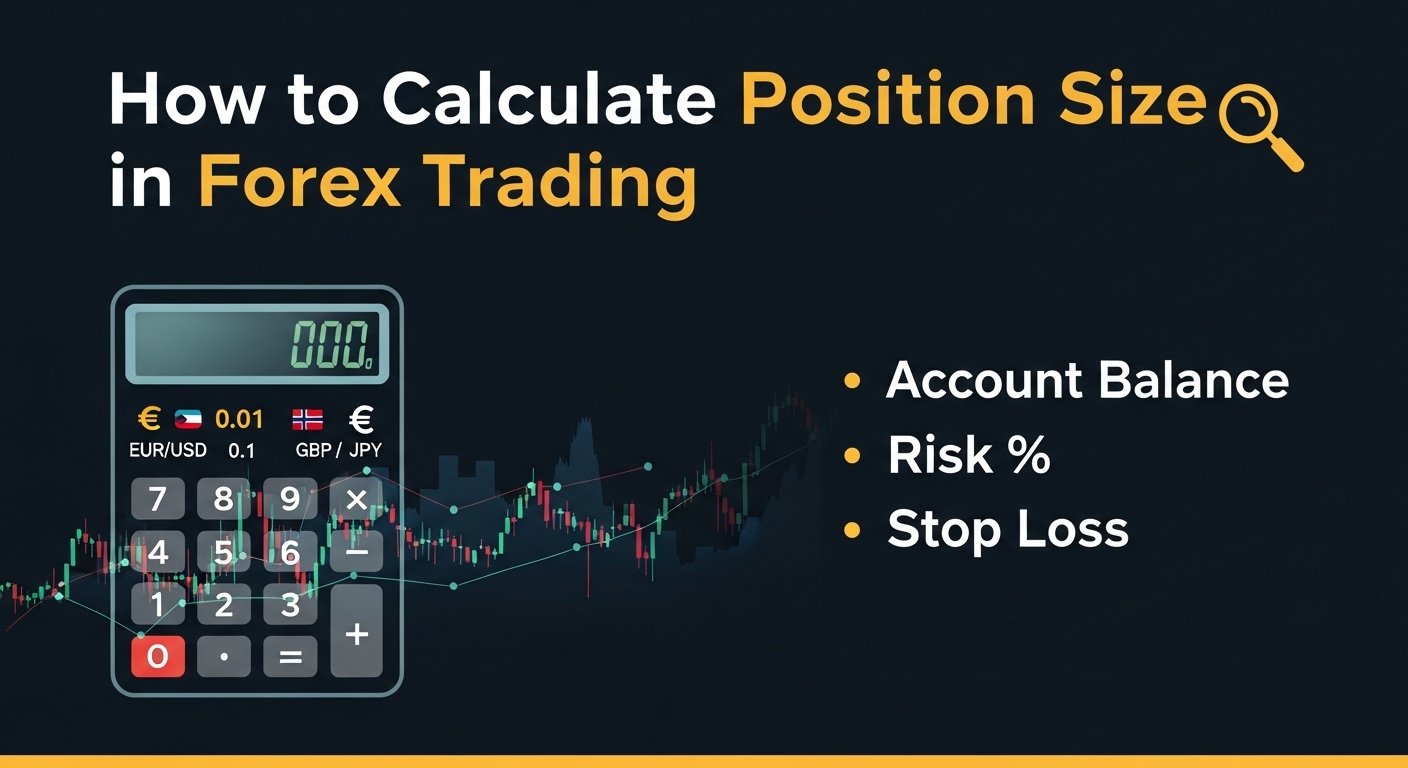
Learning how to calculate position size in Forex is the single most important skill for protecting your trading capital. Most beginners focus on finding the perfect entry point or mastering technical analysis, but they overlook the math that determines whether they survive long enough to become profitable.
Position sizing isn’t optional. It’s the difference between a manageable $50 loss and an account-blowing $500 disaster on the same trade.
Position Size – The exact number of units or lots you trade on a currency pair, calculated based on your account size, risk tolerance, and stop loss distance. Proper position sizing ensures you never risk more than a predetermined percentage of your capital on any single trade.
The position sizing formula is straightforward once you understand the components. This guide breaks down every step with real numbers, so you can calculate your trade size manually or understand what’s happening when you use a calculator.
Why Position Sizing Matters More Than Your Strategy
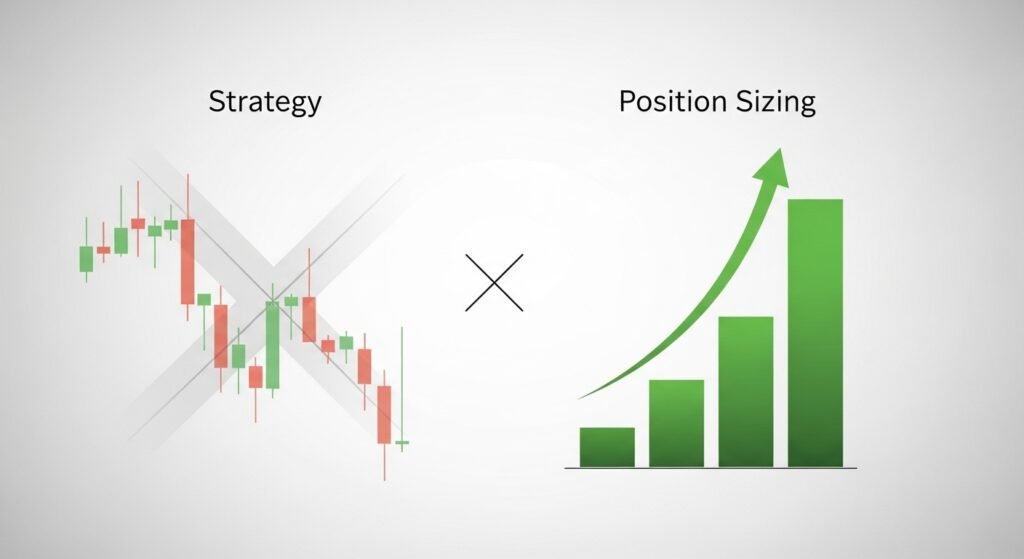
I’ve watched traders with winning strategies blow their accounts because they risked 10% per trade instead of 1%. The math is brutal: lose three trades in a row at 10% risk, and you’re down 27% of your account. At 1% risk? You’re only down 3%.
Risk Per Trade – The maximum amount of capital you’re willing to lose on a single trade, typically expressed as a percentage of your total account balance. Professional traders rarely risk more than 1-2% per trade.
Your position size directly controls your risk exposure. Trade too large, and a normal stop loss becomes a catastrophic loss. Trade too small, and even winning trades don’t move the needle on your account growth.
According to a study referenced by Investopedia, nearly 70-80% of retail Forex traders lose money, and poor risk management through incorrect position sizing is a leading cause. You can have a 60% win rate and still lose money if your position sizing is wrong.
Here’s what proper position sizing protects you from:
- Margin calls when volatility spikes unexpectedly
- Emotional trading decisions after large losses
- Account drawdown that takes months to recover from
- Overleveraging that wipes out your capital in a single session
The traders who survive aren’t necessarily the best analysts. They’re the ones who calculate their position size before every trade and stick to their risk limits religiously. If you want to understand how much you should risk per trade, starting with proper position sizing is essential.
Understanding the Core Components of Position Size Calculation
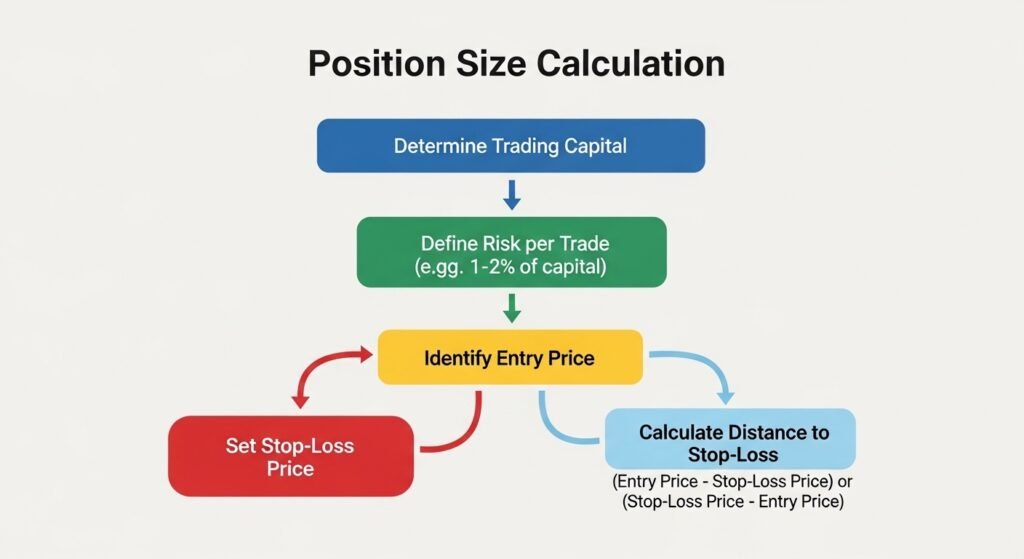
Before we jump into the formula, you need to understand what goes into the calculation. Think of these as ingredients in a recipe. Miss one, and the whole thing falls apart.
Account Balance vs. Account Equity
Account Balance – The total amount of money in your trading account before any open positions are considered. This is the number you see when all trades are closed.
Account Equity – Your account balance plus or minus any unrealized profit or loss from open positions. This number fluctuates as your open trades move in profit or loss.
Most traders make the mistake of calculating risk based on their starting balance. But if you’re already in drawdown, you should be calculating based on your current equity. With a $10,000 starting balance now sitting at $9,200 equity after some losses, you should risk 1% of $9,200 ($92), not $100.
The Risk Percentage Model
The percentage risk model is standard in professional trading. Rather than risking a fixed dollar amount, you risk a consistent percentage of your account on each trade.
Common risk percentages by trader experience:
- Beginners: 0.5-1% per trade
- Intermediate: 1-2% per trade
- Experienced: 2-3% per trade (with proven edge)
Never exceed 2% risk per trade until you’ve been consistently profitable for at least six months.
Stop Loss Distance in Pips
Stop Loss – A predetermined price level where your trade automatically closes to limit your loss. The distance between your entry price and stop loss, measured in pips, is critical for position size calculation.
Pip – The smallest price increment in Forex trading. For most currency pairs, one pip equals 0.0001, while for JPY pairs, one pip equals 0.01.
Your stop loss should be based on technical analysis: support and resistance levels, volatility, or chart patterns. Don’t set it based on how much you want to risk. That’s backwards.
If EUR/USD is trading at 1.1000 and your stop loss is at 1.0950, your pip distance is 50 pips. This number directly affects your position size. A 20-pip stop allows a larger position than a 100-pip stop for the same dollar risk. To fully understand this concept, you should learn what is a pip in Forex.
Pip Value Per Lot
Pip Value – The dollar amount each pip movement represents for a given lot size and currency pair. This varies based on the pair you’re trading and the lot size.
For a standard lot (100,000 units) on EUR/USD with a USD account, one pip equals $10. For a mini lot (10,000 units), one pip equals $1. For a micro lot (1,000 units), one pip equals $0.10.
The Position Sizing Formula Explained
Here’s the formula every Forex trader should memorize:
Position Size (in lots) = (Account Risk in $) / (Stop Loss in pips × Pip Value per lot)
Let’s break this down with a real example:
- Account Balance: $5,000
- Risk Per Trade: 1%
- Account Risk in Dollars: $50 (1% of $5,000)
- Stop Loss Distance: 40 pips
- Currency Pair: EUR/USD
- Pip Value for 1 standard lot: $10
Position Size = $50 / (40 pips × $10) = $50 / $400 = 0.125 standard lots
Since 0.125 standard lots equals 1.25 mini lots or 12,500 units, that’s your exact trade size. This formula works because it solves for the position size that makes your stop loss equal exactly $50. If you get stopped out, you lose exactly 1% of your account, no more and no less.
Step-by-Step Position Size Calculation Process
Let me walk you through the exact process I use before entering every trade. This works whether you’re trading on MT4, MT5, cTrader, or any other platform.
Step 1: Determine Your Account Risk in Dollars
Start with your current account equity, not your starting balance. If you began with $3,000 but you’re down to $2,750, use $2,750.
Decide your risk percentage. For this example, let’s use 2%:
$2,750 × 2% = $55
This is your maximum risk. If the trade hits your stop loss, you lose $55, and your account drops to $2,695.
Step 2: Set Your Stop Loss Based on Technical Analysis
Don’t pull numbers out of thin air. Your stop loss should be placed where your trade idea is invalidated.
Let’s say you’re trading GBP/USD:
- Entry Price: 1.2700
- Stop Loss: 1.2650 (below a key support level)
- Stop Loss Distance: 50 pips
Never move your stop loss further away just to fit a larger position size.
Step 3: Calculate Pip Value for Your Currency Pair
For GBP/USD with a USD account, the pip value for one standard lot (100,000 units) is $10. You can also use a pip value calculator to get exact numbers for any pair.
Step 4: Apply the Position Sizing Formula
Now plug everything into the formula:
Position Size = $55 / (50 pips × $10) = $55 / $500 = 0.11 standard lots
0.11 standard lots = 11,000 units = 1.1 mini lots
This is the exact position size that risks $55 if your stop loss is hit.
Step 5: Verify on Your Trading Platform
Before you click “Buy” or “Sell,” double-check your position size in your platform’s order window. Most platforms show you the margin required and potential pip value.
On MT4/MT5, enter 0.11 in the volume field for standard lots. Check the margin required and verify your stop loss is set correctly. Never round up your position size to “make it cleaner.” If the formula says 0.11 lots, trade 0.11 lots, not 0.15.
Most traders find manual calculations time-consuming. Skip the manual math and use our free Lot Size Calculator to get your position size in seconds. Just enter your account size, risk percentage, and stop loss distance.
Position Size Comparison Table by Account Size
The table below shows recommended position sizes for different account balances when risking 1% per trade on a 50-pip stop loss (EUR/USD).
| Account Size | 1% Risk Amount | Position Size (Standard Lots) | Position Size (Units) | Pip Value |
|---|---|---|---|---|
| $500 | $5 | 0.01 | 1,000 | $0.10 |
| $1,000 | $10 | 0.02 | 2,000 | $0.20 |
| $3,000 | $30 | 0.06 | 6,000 | $0.60 |
| $5,000 | $50 | 0.10 | 10,000 | $1.00 |
| $10,000 | $100 | 0.20 | 20,000 | $2.00 |
This table clearly shows why position sizing scales with account size. A $500 account can only trade 0.01 lots (micro lots) at 1% risk, while a $10,000 account can comfortably trade 0.20 lots with the same risk percentage.
How Leverage Affects Your Position Size
Leverage – A tool that allows you to control a larger position with a smaller amount of capital. Expressed as a ratio (like 1:100), it determines how much margin you need to open a position.
Here’s what most beginners get wrong: leverage doesn’t determine your position size. Your risk management does. Leverage only determines whether you have enough margin to open the calculated position.
With 1:100 leverage on a $2,000 account, you can control positions up to $200,000 in notional value. But that doesn’t mean you should.
Let’s say your position size calculation tells you to trade 0.05 standard lots (5,000 units) on EUR/USD at 1.1000:
- Notional value: 5,000 × 1.1000 = $5,500
- Margin required at 1:100 leverage: $5,500 / 100 = $55
- You have $2,000 in your account, so you have plenty of margin
Higher leverage is useful for traders with solid risk management who want to keep more free margin available. It’s dangerous for beginners who see it as permission to trade larger positions. Understanding what is leverage helps you use it as a tool, not a trap.
According to ESMA, leverage restrictions were implemented in 2018 for retail traders (capped at 1:30 for major pairs) specifically because excessive leverage combined with poor position sizing led to significant retail losses.
Real-World Position Sizing Examples
Example 1: Small Account on EUR/USD
- Account Balance: $800
- Risk Per Trade: 1%
- Risk in Dollars: $8
- Stop Loss Distance: 40 pips
- Pip Value (standard lot): $10
Position Size = $8 / (40 × $10) = 0.02 standard lots (2,000 units)
This is a micro lot position. With an $800 account, you’re limited to small positions, but you’re protected.
Example 2: Medium Account on GBP/JPY
- Account Balance: $6,500
- Risk Per Trade: 1.5%
- Risk in Dollars: $97.50
- Stop Loss Distance: 75 pips
- Pip Value (standard lot): $6.63
Position Size = $97.50 / (75 × $6.63) = 0.196 standard lots
Round down to 0.19 standard lots (19,000 units).
Example 3: Larger Account on AUD/USD
- Account Balance: $15,000
- Risk Per Trade: 1%
- Risk in Dollars: $150
- Stop Loss Distance: 30 pips
- Pip Value (standard lot): $10
Position Size = $150 / (30 × $10) = 0.50 standard lots
Half a standard lot on a $15,000 account with a tight 30-pip stop.
Common Mistakes Traders Make with Position Sizing
1. Using a Fixed Lot Size Regardless of Stop Loss Distance
Trading 0.1 lots on every trade sounds simple, but it’s dangerous. A 30-pip stop with 0.1 lots risks $30. A 100-pip stop with the same position risks $100. Always calculate position size based on your stop loss distance.
2. Calculating Risk Based on Starting Balance Instead of Current Equity
If your $10,000 account is down to $8,500, you should risk 1% of $8,500 ($85), not $100. Check your current equity before every trade.
3. Ignoring Pip Value Differences Across Currency Pairs
JPY pairs have different pip values than EUR/USD. Always verify the pip value for the specific pair you’re trading.
4. Moving Stop Loss to Fit Desired Position Size
Your stop loss placement should be based on market structure, not on how much you want to trade. Don’t move your stop closer just to trade a larger position.
5. Overriding the Formula During Winning or Losing Streaks
Stick to your risk percentage regardless of recent results. The formula doesn’t care about your emotions, and neither does the market.
Position Sizing for Different Lot Types
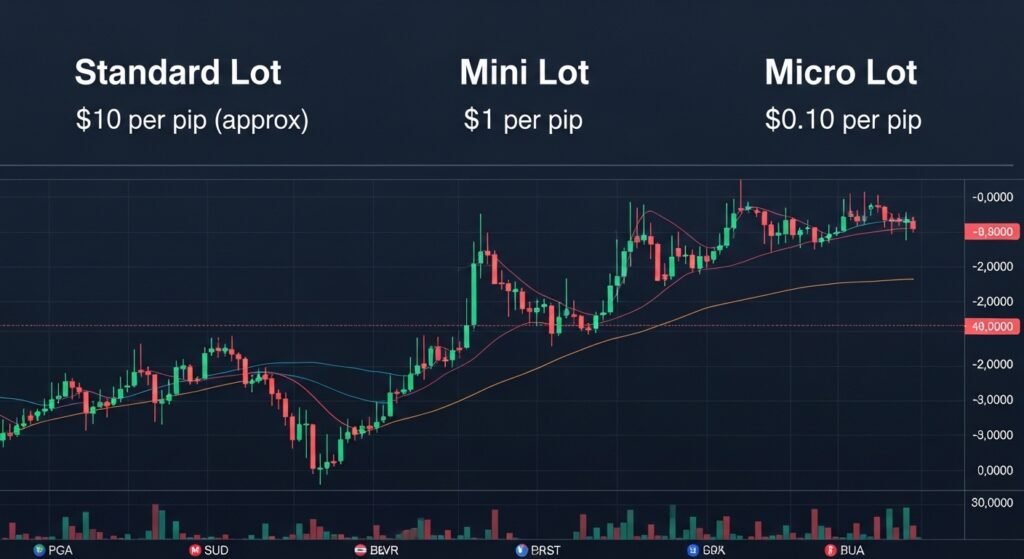
Lot Size – A standardized unit of measurement in Forex trading representing a specific number of units of the base currency in a currency pair.
Understanding the different lot sizes helps you execute the position your formula calculates. For a complete breakdown, check out what is lot size in Forex.
| Lot Type | Units of Base Currency | Pip Value (EUR/USD) | Recommended Account Size |
|---|---|---|---|
| Nano Lot | 100 | $0.01 | Practice accounts |
| Micro Lot | 1,000 | $0.10 | $200-$500 |
| Mini Lot | 10,000 | $1.00 | $500-$3,000 |
| Standard Lot | 100,000 | $10.00 | $3,000+ |
When your position size calculation returns 0.07 lots, that’s 7,000 units or 7 micro lots or 0.7 mini lots. For more details on the calculation process, see how to calculate lot size in Forex.
Tools to Speed Up Position Size Calculations
Calculating position size manually before every trade gets tedious. A good position size calculator asks for your account balance, risk percentage, stop loss distance, and currency pair, then instantly returns your exact lot size.
Not sure what position size to use? Try our Risk Calculator to see exactly how much you’re risking based on your account size and trade parameters.
Even if you use calculators, understand the formula. When the calculator returns a number, you should know whether it’s reasonable. A $1,000 account shouldn’t be trading 1 standard lot at 1% risk.
Frequently Asked Questions
What is the best position size for a $500 Forex account?
With a $500 account, risk no more than 1% per trade ($5). Your position size depends on your stop loss distance. For a 50-pip stop on EUR/USD, you’d trade 0.01 lots (1,000 units). Always calculate based on your specific stop loss, not a fixed lot size.
How do I calculate position size without a calculator?
Use the formula: Position Size = (Account Risk in $) / (Stop Loss in pips × Pip Value). For example, with $50 risk, a 40-pip stop, and $10 pip value: $50 ÷ (40 × $10) = 0.125 standard lots. The math is basic division.
What happens if I use too large a position size?
Overleveraging means a normal stop loss becomes an outsized loss. Risk 10% per trade, and three consecutive losses drop your account by 27%. You’ll also face margin calls faster and make emotional decisions after big losses. Always stick to 1-2% maximum risk.
Should I calculate position size based on balance or equity?
Always use current equity, especially if you have open positions or are in drawdown. If your $10,000 account is at $8,700 equity, risk 1% of $8,700 ($87), not $100.
How does stop loss distance affect position size?
Wider stops require smaller positions for the same dollar risk. A 100-pip stop allows half the position size of a 50-pip stop. Never move your stop closer just to trade a larger position.
Can I use the same position size for all currency pairs?
No. Different pairs have different pip values, especially JPY pairs. Always calculate position size for each pair individually. Your position size formula accounts for these differences automatically.
Is a micro lot good for beginners?
Yes. Micro lots (1,000 units) are perfect for small accounts and beginners. With a $0.10 pip value on EUR/USD, you can practice risk management without significant capital exposure.
Conclusion
Position sizing is the foundation of risk management. You can have mediocre entries and still make money if your position sizing is disciplined. You can have perfect technical analysis and blow your account if you overleverage.
The formula is simple: divide your dollar risk by your stop loss distance and pip value. What’s hard is the discipline to calculate it every time and the restraint to not override it when you’re feeling confident or desperate.
Most traders who fail don’t fail because they couldn’t learn chart patterns. They fail because they risked too much, too often, and ran out of capital before their edge could play out.
Calculate your position size before every trade. Make it as automatic as setting your stop loss. The market will test you with losing streaks and unexpected volatility. Proper position sizing ensures you survive those tests.