What Is a Pip in Forex? Beginner-Friendly Guide With Examples

If you are starting your journey in foreign exchange, one of the first terms you must understand is a pip. Every trade you take, every chart you analyze, and every result you measure is calculated in pips.
Without understanding what a pip in forex trading is, you cannot properly measure profit or loss, manage risk, or build a consistent strategy. This guide explains everything clearly with real examples.
What Is a Pip in Forex?
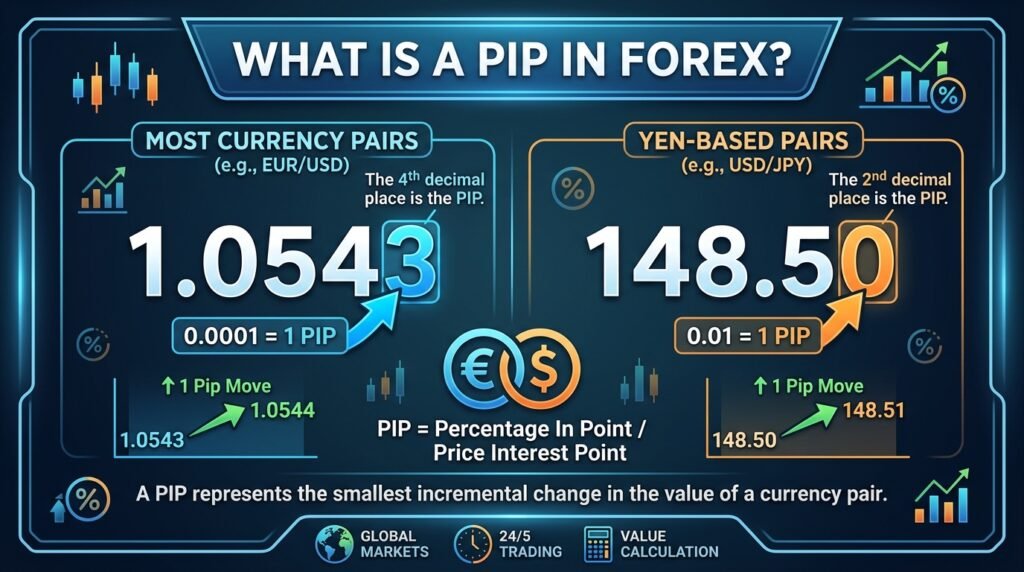
A pip stands for percentage in point, and it is the standard unit used to measure price movement in a currency pair. It helps traders quantify how much the market has moved.
In simple words, a pip tells you how much the exchange rate has changed between two prices. Forex traders around the world rely on this measurement daily.
For most currency pairs, one pip equals a movement in the fourth decimal place. This rule applies to the majority of major pairs.
How Currency Pairs Are Quoted in Pips
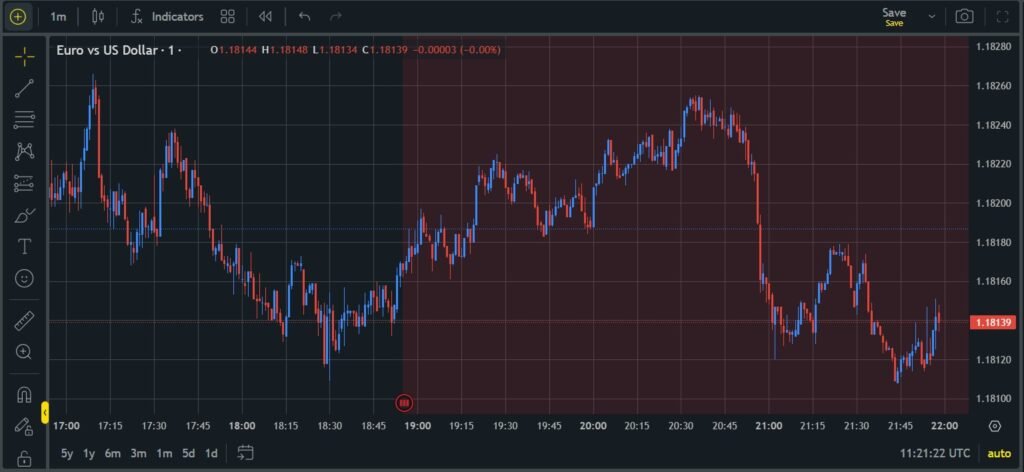
To understand pips properly, you must know how currency pairs are displayed. Most major pairs are quoted with four decimal places.
For example, eur usd may appear as 1.1050. Here, the last digit (0) represents one pip because it is the fourth decimal.
If the price moves from 1.1050 to 1.1051, that is a 1 pip move. If it moves to 1.1060, that equals 10 pips.
Understanding the Fourth and Fifth Decimal
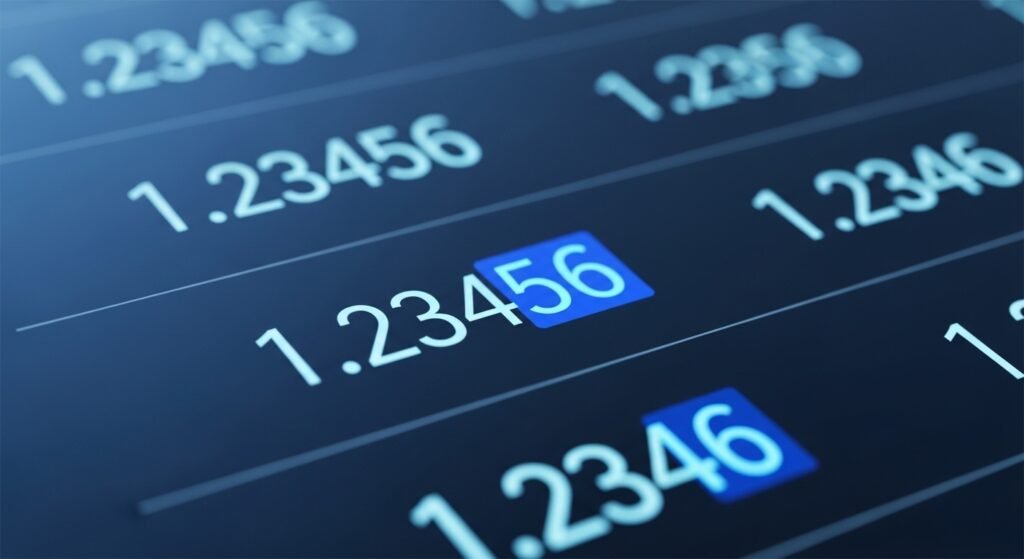
Traditionally, pairs are quoted to four decimal places, and the fourth decimal represents one pip. This is the standard definition used in forex education.
However, modern brokers now add a fifth decimal place. This extra digit is called fractional pips or a pipette.
For example, if EUR/USD is shown as 1.10508, the fourth decimal (0) is one pip, while the fifth decimal (8) is 0.8 of a pip. The fifth digit simply gives more precise pricing.
Special Case: Japanese Yen Pairs
Pairs involving the japanese yen work slightly differently because of how their exchange rate is structured. Instead of four decimals, they use two.
For example, usd jpy might be quoted as 150.25. In this case, the second decimal place represents one pip.
If USD/JPY moves from 150.25 to 150.26, that equals a 1 pip move. Even though the format looks different, the concept remains the same.
EUR/USD Real Example (Step-by-Step)
Let’s break this down clearly using eur usd. Imagine you buy the pair at 1.1000 and later close the trade at 1.1008.
To calculate the pip move, subtract the entry from the exit price. The difference is 0.0008, which equals 8 pips.
If you were buying, that would be an 8 pip profit. If you were selling, it would be an 8 pip loss.
USD/JPY Real Example (Step-by-Step)
Now let’s use usd jpy to reinforce your understanding. Suppose you enter at 150.20 and close at 150.28.
The difference is 0.08. Since JPY pairs use the second decimal place, that equals 8 pips.
Even though the decimals look different from EUR/USD, the pip calculation logic is identical.
Real 8 Pip Trading Example With Money
Now let’s connect pips to real money. Suppose you captured an 8 pip move on EUR/USD.
Your actual profit or loss depends on your lot size. This is where many beginners get confused.
If you trade a standard lot, each pip is worth about $10. If you trade a mini lot (10,000 unit), each pip is worth about $1.
Pip Value by Lot Size (EUR/USD)
| Lot Size | Units Traded | Value of 1 Pip | 8 Pip Profit |
|---|---|---|---|
| Standard Lot | 100,000 | $10 | $80 |
| Mini Lot | 10,000 unit | $1 | $8 |
| Micro Lot | 1,000 | $0.10 | $0.80 |
This table shows how pip value changes based on position size. Even a small pip move can become large when trading bigger lots.
If you capture 50 pips using a standard lot, that equals $500. The same 50 pips with a micro lot equals only $5.
How to Calculate Pip Value
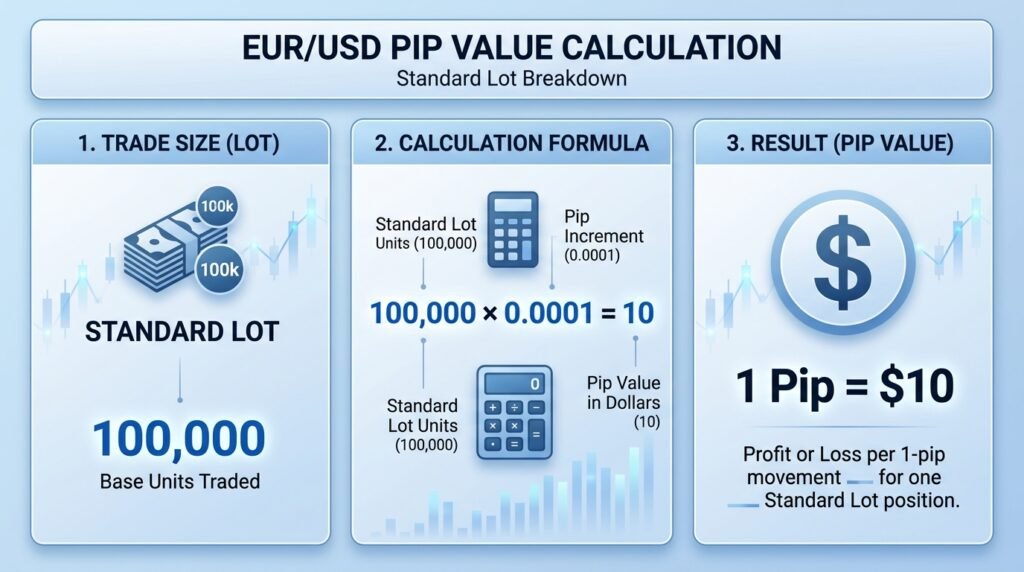
Pip value depends on the lot size and the base currency of the pair. For USD-based pairs, a standard lot typically equals $10 per pip.
For a mini lot (10,000 unit), one pip is approximately $1, and for a micro lot, one pip is around $0.10. If you want an exact calculation based on the current exchange rate, you can use a reliable pip value calculator to avoid manual errors.
For pairs like USD/JPY, pip value changes slightly depending on the exchange rate. That is why professional forex traders always calculate position size carefully before entering a trade, often using a trusted pip value calculator tool to manage risk accurately.
Are Pips and Points the Same?
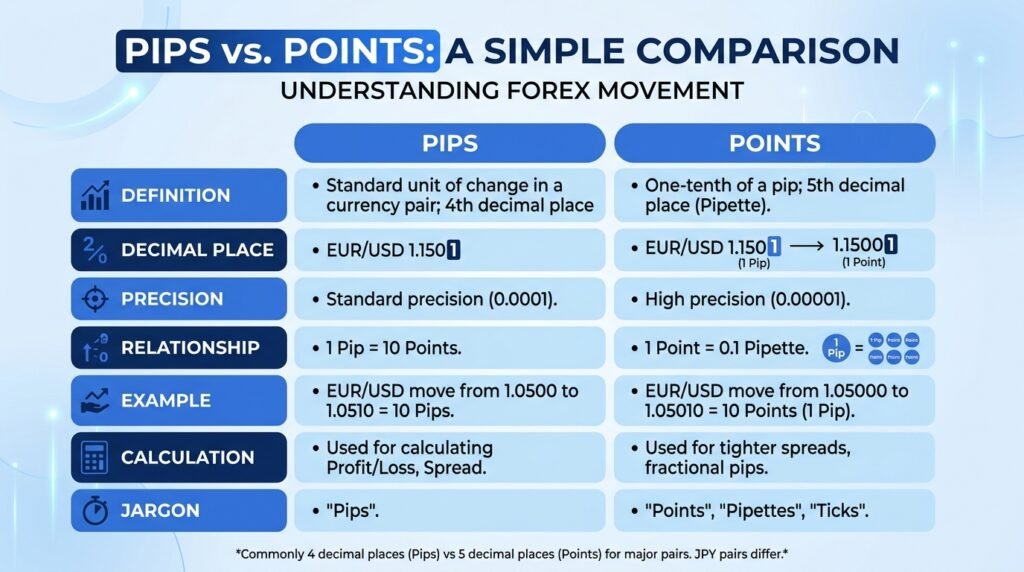
This is one of the most common beginner questions in forex. Technically, pip stands for percentage in point.
However, brokers often use the word “point” differently. In many trading platforms, one point equals the smallest price movement.
For example, if EUR/USD moves from 1.10000 to 1.10001, that is one point but only 0.1 pip. So pips and points are not always the same.
What Does a 50 Pips Move Mean?
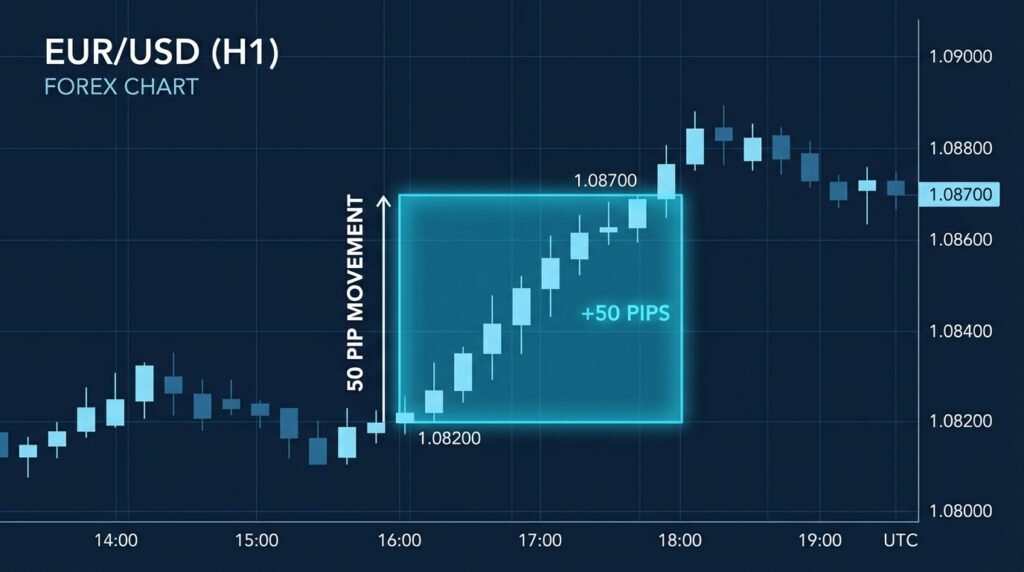
When traders say the market moved 50 pips, they mean price changed by 0.0050 in most major pairs.
For example, if EUR/USD moves from 1.1000 to 1.1050, that equals 50 pips. This is considered a solid intraday move.
With a standard lot, 50 pips equals $500. This shows why understanding pip movement is critical.
Why Pips Matter for Risk Management
Smart traders think in pips before they think in dollars. Every trade begins with defining risk in pips.
For example, you may set a stop loss of 20 pips and a take profit of 40 pips. That creates a 1:2 risk-to-reward ratio.
Risk management is not about chasing big moves. It is about controlling how many pips you are willing to lose per trade.
How Pips Affect Profit or Loss
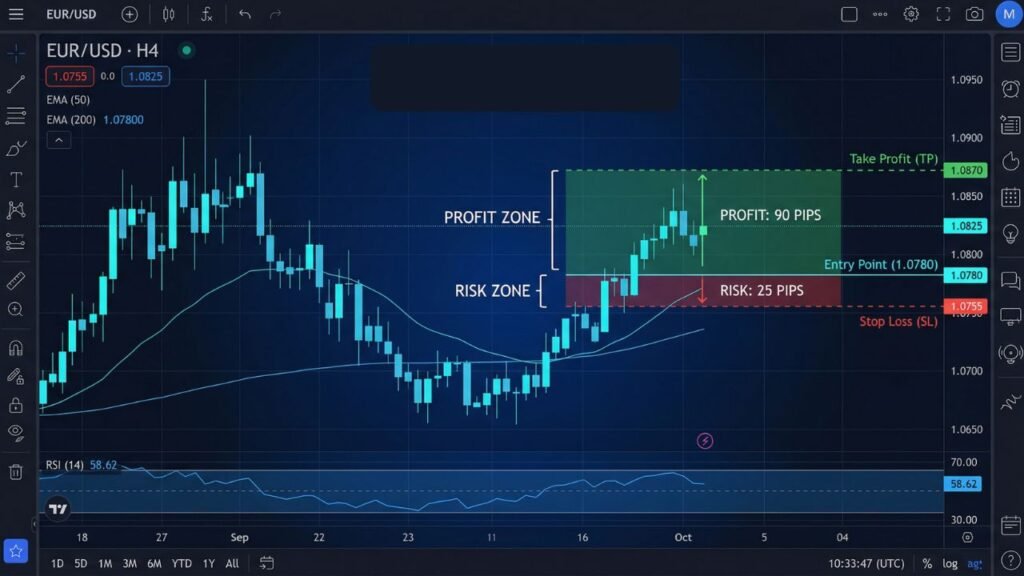
Your total profit or loss depends on three factors: pip move, lot size, and trade direction. All three must be calculated before entry.
Even a small 10 pip loss can hurt if your lot size is too big. On the other hand, small consistent gains can grow your account steadily.
Successful forex traders focus on consistency in pip gains rather than emotional trading decisions.
Beginner Mistakes With Pips
Many beginners confuse the fourth decimal with the fifth decimal. This leads to incorrect pip calculations.
Another mistake is ignoring lot size and focusing only on pip count. A 30 pip loss on a large lot can wipe out an account quickly.
Always calculate risk as a percentage of your account before placing any trade. Discipline matters more than excitement.
Quick Recap: What You Must Remember
A pip measures price movement in a currency pair. Most pairs use the fourth decimal, while JPY pairs use the second decimal.
Fractional pips represent the fifth decimal and provide more precise pricing. Pip value depends on lot size and exchange rate.
Understanding pips is the foundation of trading success in foreign exchange.
Frequently Asked Questions (FAQ)
What is a pip?
A pip is the standard unit used to measure price movement in the forex market. For most currency pairs, it equals the movement in the fourth decimal place.
It allows forex traders to measure market changes consistently across different pairs.
How much is one pip worth?
The value of one pip depends on your lot size. For EUR/USD, a standard lot equals about $10 per pip.
A mini lot equals about $1 per pip, and a micro lot equals about $0.10 per pip.
Are pips and points the same?
Not always. A pip usually represents the fourth decimal movement in most pairs.
A point often refers to the smallest price movement, which may be the fifth decimal.
How do you calculate pips?
Subtract your entry price from your exit price. For EUR/USD, 1.1008 minus 1.1000 equals 0.0008, which equals 8 pips.
For USD/JPY, 150.28 minus 150.20 equals 0.08, which equals 8 pips.
Conclusion
Understanding what a pip in forex trading is gives you a solid foundation in the foreign exchange market. Every price movement, every trade decision, and every profit or loss is measured in pips, making it the core unit of trading.
Once you clearly understand the fourth decimal, fractional pips, and how pairs like eur usd and usd jpy are quoted in pips, the confusion disappears. You begin to read charts with confidence and calculate moves accurately.
Most importantly, pips are the backbone of risk management and smart position sizing. Master this concept, and you move from guessing in the market to trading with structure, control, and long-term focus.