What Is Leverage in Forex? How $100 Controls $10,000

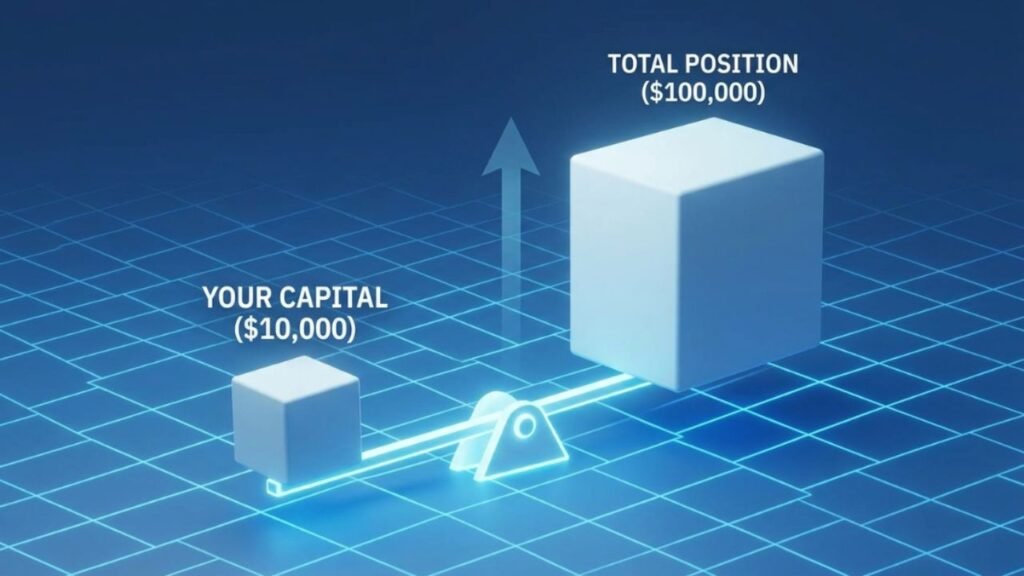
What if you could trade $10,000 worth of currency with just $100 in your account? That’s the basic premise behind leverage in forex — and it’s the reason forex attracts millions of traders worldwide.
In simple terms, leverage in forex is borrowed capital that allows you to open positions much larger than your actual account balance. It’s one of the most powerful features in currency trading, and also one of the most misunderstood.
In this guide, you’ll learn exactly what leverage is, how it works step by step, how it connects to margin, which leverage ratio suits your experience level, and — critically — how to use it without blowing your account.
Whether you’re just starting out or looking to sharpen your risk management, this article covers everything you need about leverage in forex trading in plain, practical terms.
What Is Leverage in Forex?
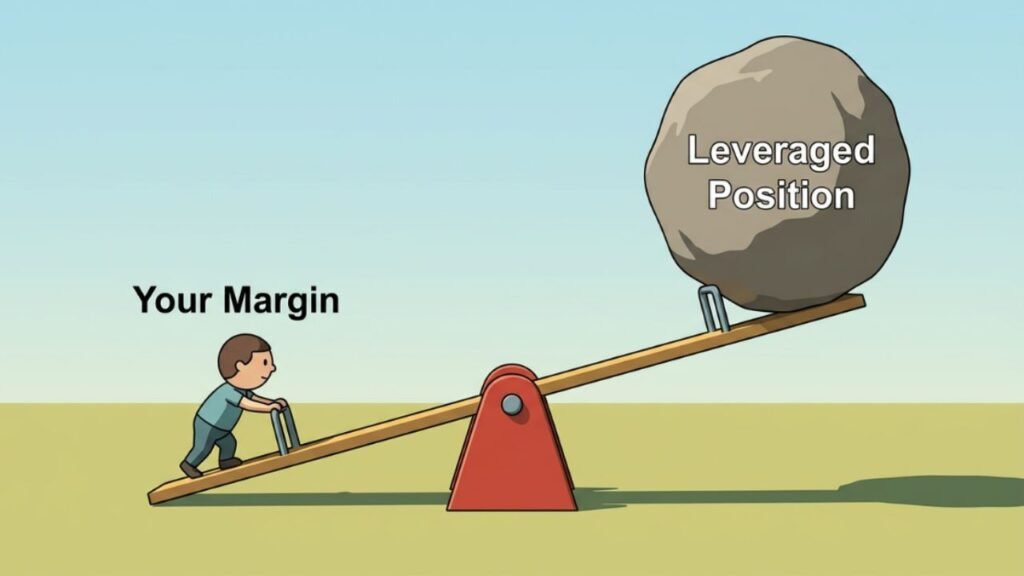
Leverage is a mechanism that lets you control a large position in the forex market with a relatively small amount of your own capital. The broker effectively lends you the remaining funds needed to open the full position.
Think of it like buying a house with a mortgage. You put down 10% — say $30,000 — and the bank covers the remaining $270,000. You control the full $300,000 asset with a fraction of its value. Forex leverage works on the same principle, except the “bank” here is your broker, and the “asset” is a currency pair position.
The Leverage Ratio Format: Forex Leverage Ratio Explained
Leverage in forex is expressed as a ratio — for example, 1:50, 1:100, or 1:500. The first number is always 1 (your capital), and the second number is the total position you can control.
| Leverage Ratio | Your Capital | Position You Control | Borrowed Funds |
| 1:10 | $1,000 | $10,000 | $9,000 |
| 1:50 | $1,000 | $50,000 | $49,000 |
| 1:100 | $1,000 | $100,000 | $99,000 |
| 1:500 | $1,000 | $500,000 | $499,000 |
The broker-trader relationship is straightforward: you deposit a percentage of the trade value (called margin), and the broker provides the rest. The broker doesn’t charge interest on standard spot forex positions, but overnight trades do carry swap/rollover costs — more on that later.
How Does Leverage Work in Forex Trading?
The Basic Mechanics
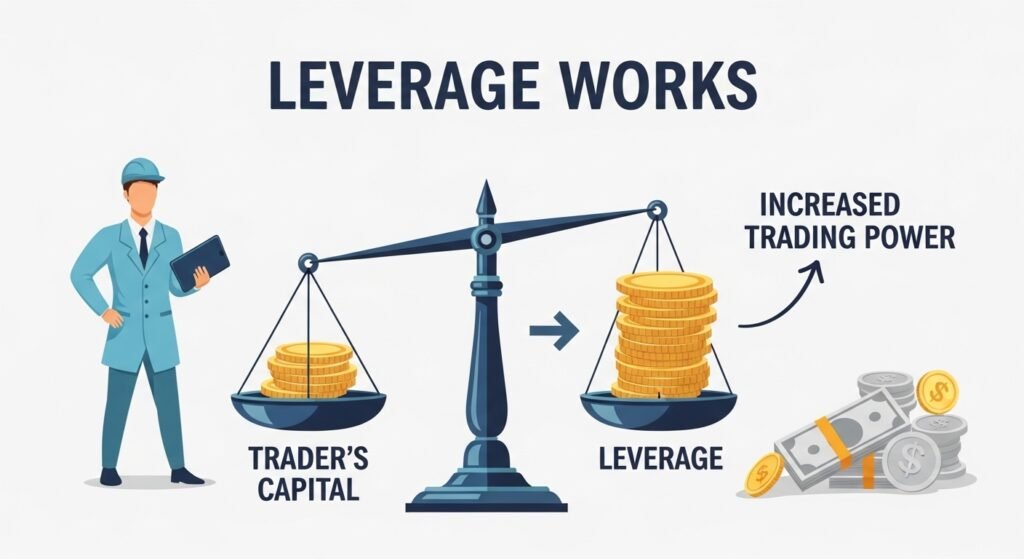
When you open a leveraged trade, three things happen simultaneously: your broker sets aside a portion of your account as collateral (margin), opens the full-size position in the market on your behalf, and monitors your account in real time.
Here’s a step-by-step breakdown of how it flows:
- You deposit funds into your broker account — say, $1,000.
- You choose a currency pair and set a position size — for example, 1 standard lot of EUR/USD (worth $100,000).
- With 1:100 leverage, your broker requires a $1,000 margin deposit (1% of $100,000) and funds the remaining $99,000.
- The trade moves. If EUR/USD rises 1%, your $100,000 position gains $1,000 — a 100% return on your $1,000 capital.
- If EUR/USD falls 1%, you lose $1,000 — your entire deposit — before the broker steps in.
- When you close the trade, borrowed funds return to the broker. You keep (or absorb) the profit or loss.
The broker isn’t exposed to your loss beyond a certain point. That’s why they monitor your equity closely — and why margin calls and stop-outs exist.
What Does 1:100 Leverage Mean in Forex?
If you see a broker offering 1:100 leverage, it means for every $1 you deposit, you can control $100 in the market. A $500 account becomes the equivalent of $50,000 in trading power. This amplification is why leverage is often described as a double-edged sword — it magnifies both gains and losses by the same multiple.
Leverage vs Margin in Forex — What’s the Difference?
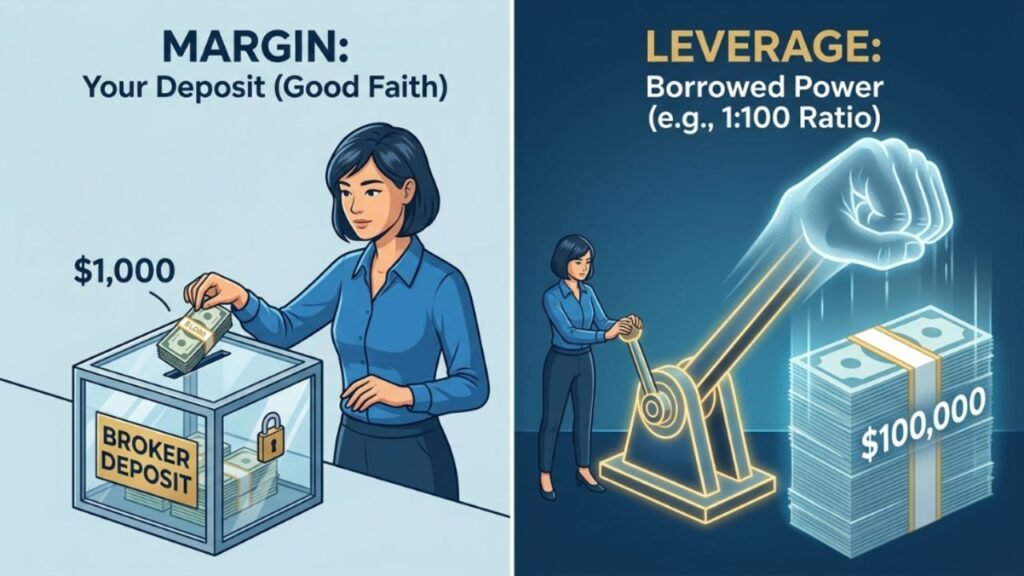
Leverage and margin are two sides of the same coin, yet many beginners confuse them. Here’s the distinction that matters.
What Is Margin in Forex?
Margin is not a cost — it’s collateral. It’s the amount your broker holds aside from your account balance to cover potential losses on your open position. Think of it as a security deposit, not a fee.
There are three margin terms every trader must know:
- Used Margin: the funds currently locked up in open trades.
- Free Margin: the portion of your equity not yet committed to a trade — what you can open new positions with.
- Equity: your account balance plus or minus any floating profits or losses from open trades.
How Leverage and Margin Are Connected
The relationship is a simple formula:
Margin Required = Trade Size ÷ Leverage
Example: You want to open a $100,000 EUR/USD position using 1:100 leverage.
$100,000 ÷ 100 = $1,000 margin required.
For more on calculating position sizing, see our guide on lot size in forex and how it connects to margin requirements.
Margin Call and Stop-Out Level
A margin call is a warning from your broker that your free margin is running low due to losses on open positions. It’s a signal to either deposit more funds or close losing trades.
A stop-out level is when the broker automatically closes your open positions to prevent your account from going into a negative balance. For most retail brokers, this triggers when equity drops to 20–50% of used margin, though it varies by broker and regulator.
Understanding margin in forex in detail is essential before increasing your leverage.
Real Trade Example — With and Without Leverage
Trading EUR/USD Without Leverage
You have $10,000. EUR/USD moves 50 pips in your favour (a fairly typical intraday move). With no leverage, your $10,000 controls a mini lot (10,000 units). Each pip is worth roughly $1, so 50 pips = $50 gain. That’s a 0.5% return on capital.
Trading EUR/USD With 1:100 Leverage
Same $10,000 account, same 50-pip move, but now using 1:100 leverage. You open a $1,000,000 position (10 standard lots). Each pip is now worth $100. 50 pips = $5,000 gain. That’s a 50% return on capital.
Sounds incredible — until you flip it. If the market moves 50 pips against you, you lose $5,000. 100 pips against you, and you’ve wiped out your account.
| Scenario | No Leverage | 1:100 Leverage |
| Account Size | $10,000 | $10,000 |
| Position Size | $10,000 (mini lot) | $1,000,000 (10 lots) |
| Pip Value | ~$1 | ~$100 |
| +50 pips (profit) | +$50 (+0.5%) | +$5,000 (+50%) |
| -50 pips (loss) | -$50 (-0.5%) | -$5,000 (-50%) |
| -100 pips (loss) | -$100 (-1%) | -$10,000 (account wiped) |
Key Lesson
Leverage doesn’t change the direction of the market or improve your win rate. It amplifies whatever outcome the market delivers. A strategy that works with modest leverage can destroy an account with excessive leverage — the underlying performance is identical.
Types of Leverage Ratios — Which Is Right for You?
Low Leverage (1:2 – 1:20) — Conservative
This is the regulatory standard in the United States (CFTC/NFA) and the European Union (ESMA), where retail forex traders are capped at 1:30 on major pairs and 1:20 on minors. It’s also the approach recommended by most professional risk managers.
Low leverage is best for beginners because losses scale slowly, giving you time to learn without wiping out your account on a few bad trades. Experienced traders working with large accounts also often prefer this range for capital preservation.
Medium Leverage (1:50 – 1:100) — Moderate
The sweet spot for many intermediate traders who have a tested strategy, a solid risk management framework, and genuine understanding of position sizing. Most retail forex brokers operating under regulatory oversight offer this range.
At 1:100, even a well-run account can be damaged quickly by a string of losses or a sudden news-driven spike. Risk per trade discipline — typically 1–2% of account per trade — becomes non-negotiable here.
High Leverage (1:200 – 1:500+) — Aggressive
Available primarily through offshore and loosely regulated brokers. While not inherently illegal, the combination of high leverage and thin regulatory protection creates significant risk for retail traders.
In practice, professional traders rarely use leverage this high. The margin for error is so small that even a technically sound setup can result in a stop-out before the trade has time to develop. High leverage is not a feature that makes you a better trader — it’s an amplifier that makes your mistakes more expensive.
What is the best leverage for beginners in forex? Start with 1:10 or 1:20. This gives you exposure to real market moves without the account-threatening downside that higher ratios introduce.
Pros and Cons of Using Leverage in Forex
Advantages
- Access larger positions than your capital would otherwise allow
- Diversify across multiple currency pairs simultaneously
- Profit from both rising and falling markets with equal efficiency
- Lower barrier to entry for retail traders — accounts can start from as little as $100
Disadvantages
- Losses are magnified to exactly the same degree as gains
- Risk of margin calls and partial or total account wipeout
- Overnight positions incur swap fees that compound over time
- Psychological pressure increases sharply with higher leverage — emotions drive poor decisions
Risks of High Leverage in Forex Trading

Margin Call Explained
When your open losses erode your free margin below your broker’s threshold (commonly 100% of used margin), the broker issues a margin call. This is an automated notification — not a request. You either add funds immediately or start closing positions.
Stop-Out Level
If losses continue after a margin call and your equity falls to the stop-out level (often 20–50% of used margin), the broker auto-closes your largest losing position first, then continues until equity recovers above the threshold. You have no control over which positions close or at what price.
Leverage and Emotional Trading
From experience, one of the most underrated risks of high leverage is its psychological impact. When a $100 move means a $5,000 swing in your equity, rational decision-making degrades fast. Traders freeze on valid exits, widen stop-losses impulsively, or double down on losing positions — all classic stress responses that compound losses.
Statistics Worth Knowing
Analyses across EU jurisdictions show that 74–89% of retail CFD accounts lose money, with average losses per client ranging from €1,600 to €29,000 European Securities and Markets Authority — figures published in the official ESMA product intervention press release. The UK’s FCA built directly on that evidence, making leverage restrictions permanent and requiring all CFD firms to disclose their own percentage of loss-making retail accounts in their risk warnings.
Use our forex risk management calculator to model how leverage exposure affects your downside before placing a trade.
How to Use Leverage Safely — Risk Management Tips
Always Use a Stop-Loss Order
A stop-loss automatically closes your position if price moves against you by a predetermined amount. Without one, a leveraged trade can run far beyond your intended loss threshold — particularly during volatile news events like NFP releases or central bank decisions.
Risk No More Than 1–2% Per Trade
This is the most widely cited rule in professional trading. If your account is $5,000 and you risk 2% per trade, your maximum loss per trade is $100. You’d need 50 consecutive losses to wipe the account — giving your strategy enough sample size to prove or disprove itself.
Start With Low Leverage (1:10 or 1:20)
A common mistake professionals make is starting at higher leverage because they’re confident in their strategy. The problem isn’t the strategy — it’s that live markets behave differently from backtested data, and the account needs breathing room during the learning curve. Start conservative, scale up only when your equity curve demonstrates consistency.
Use a Demo Account First
Every reputable broker offers a risk-free demo environment. Test your leverage usage, margin management, and stop-loss discipline with simulated funds before risking real capital. Two to three months on a demo account is a reasonable baseline before going live.
Understand Swap and Rollover Costs
If you hold a position overnight, your broker charges or pays a swap — the interest rate differential between the two currencies in the pair. On highly leveraged positions, these costs accumulate daily and can significantly erode profits on longer-term trades. Check your broker’s swap table before holding positions for more than a day.
Global Leverage Regulations by Country
Leverage limits vary significantly depending on where you trade and which regulator oversees your broker. This matters because an offshore broker offering 1:2000 leverage is not subject to the same client protection rules as an FCA-regulated UK broker.
| Region / Regulator | Max Retail Leverage | Major Pairs | Notes |
| ���� USA (CFTC / NFA) | 1:50 | 1:50 | Strict compliance; NFA registration required |
| ���� UK (FCA) | 1:30 | 1:30 | Client fund segregation mandatory |
| ���� EU (ESMA) | 1:30 | 1:30 | Leverage warnings & risk disclosures required |
| ���� Australia (ASIC) | 1:30 | 1:30 | Retail leverage capped since 2021 |
| ���� Pakistan (SECP) | Varies | ~1:100 | SECP oversight; broker-specific limits |
| ���� South Africa (FSCA) | 1:500 (offshore) | Varies | Regulated local brokers offer 1:100 |
| Offshore Brokers | Up to 1:2000 | Up to 1:2000 | Higher risk, reduced client protection |
Offshore doesn’t automatically mean unregulated — some offshore jurisdictions (Vanuatu, Seychelles, Labuan) do licence brokers. But their enforcement mechanisms and investor compensation schemes are generally weaker than Tier-1 regulators like the FCA, ASIC, or CFTC.
Forex Leverage Calculator — How to Calculate Your Own
Before opening any leveraged trade, calculate the margin required and your maximum loss. The formula is straightforward:
Margin Required = Trade Size ÷ Leverage Ratio
Pip Value = (Pip Size × Trade Size) ÷ Exchange Rate
Example: You want to open a 0.5 lot (50,000 units) EUR/USD trade with 1:50 leverage.
Margin Required = 50,000 ÷ 50 = $1,000.
At $5 per pip, a 200-pip move against you = $1,000 loss — your entire margin.
Most brokers provide a built-in forex leverage calculator in their platform. Use it before every trade.
Frequently Asked Questions — Leverage in Forex
What is leverage in forex in simple terms?
Leverage in forex lets you control a large trade position using a small amount of your own money. A 1:100 leverage ratio means $1 of your capital controls $100 in the market. It amplifies both profits and losses proportionally.
Is leverage free in forex trading?
Leverage itself has no direct cost on intraday trades. However, if you hold a leveraged position overnight, your broker charges a swap fee — the interest cost of borrowing. For short-term trades closed within the same day, leverage is effectively free of financing charges.
Can I lose more than I deposit with leverage?
With most regulated brokers, no. Negative balance protection — mandatory under FCA and ESMA rules — ensures your loss is capped at your account balance. With unregulated offshore brokers, this protection may not exist, and losses can exceed your deposit.
What leverage should a beginner use in forex?
1:10 or 1:20 is the recommended starting point for beginners. This range limits potential losses while still giving you meaningful exposure to market moves. Avoid leverage above 1:50 until you have at least six months of consistent, profitable trading on a demo account.
What does 1:100 leverage mean in forex?
1:100 leverage means for every $1 in your account, you can open a $100 position. A $500 account controls $50,000 in the market. A 1% move in your favour returns $500 (100% of your deposit). A 1% move against you wipes out your $500 deposit entirely.
Is high leverage good or bad in forex?
High leverage is neither good nor bad — it depends entirely on how it’s used. Used with a solid risk management plan, appropriate position sizing, and disciplined stop-losses, moderate leverage can enhance returns. Used recklessly or without experience, high leverage accelerates account destruction.
How is leverage different from a loan?
Unlike a bank loan, forex leverage carries no application process, repayment schedule, or interest charges on intraday positions. The broker provides capital automatically when you open a position. When you close the trade, borrowed funds are returned instantly. Swap fees apply only to overnight positions — they’re the forex equivalent of financing costs.
Final Thoughts — Leverage Is a Tool, Not a Shortcut
Leverage is what makes forex accessible to retail traders around the world — it’s the mechanism that lets a $500 account participate in currency markets that institutional traders navigate with millions. But accessibility isn’t the same as simplicity.
The traders who use leverage successfully over the long term are not the ones chasing 1:500 ratios. They’re the ones who understand their risk per trade, set stop-losses before entering positions, and treat leverage as a precision instrument rather than a multiplier for excitement.
Start on a demo account. Use our forex risk management calculator to model your exposure. Study what pip values mean in relation to your leverage. And when you go live, start with leverage ratios of 1:10 or 1:20 until your strategy proves itself.
Leverage doesn’t change the market. It changes what the market can do to you — in both directions. Respect that, and it becomes a genuine advantage.
This article is for educational purposes only and does not constitute financial or investment advice. Forex trading carries significant risk of capital loss. Past performance is not indicative of future results. Always trade within your means and seek independent financial advice if needed.