How to Handle a Losing Trade Emotionally (A Beginner’s Guide)


Your stop loss just got hit. Again.
Your chest feels tight. Your first instinct is to open a new chart and jump right back in.
That reaction is normal. It is also one of the most expensive habits in trading.
Regulatory data backs this up. The Commodity Futures Trading Commission notes that about two out of three retail foreign exchange traders end each quarter in the red. Losing trades are not rare exceptions. They are a routine part of this business.
What separates traders who survive from traders who blow up their accounts is not a magic strategy. It is how they respond emotionally in the minutes and hours after a loss.
In this guide, you will learn what actually happens in your brain after a loss. You will also get a practical, step by step routine for handling that moment so it does not turn into a much bigger problem.
- Why a Losing Trade Hits Harder Than the Math Says It Should
- The Four Emotional Stages Traders Go Through After a Loss
- What to Do in the First Five Minutes After a Loss
- What Not to Do After a Losing Trade
- Reframing Losses as a Normal Cost of Trading
- Building a Post Loss Routine That Protects Your Account
- Using Numbers Instead of Feelings to Recover
- When a Losing Streak Means It Is Time to Stop
Why a Losing Trade Hits Harder Than the Math Says It Should
A $100 loss does not feel like the emotional opposite of a $100 gain. It feels much worse.
This is not a personal weakness. It is a documented feature of how human brains process risk.
Nobel laureate Daniel Kahneman and his research partner Amos Tversky studied this extensively. Their research found that losses hurt roughly twice as much as equivalent gains feel good, a finding known as loss aversion. Later work by the same researchers refined that estimate, showing losses are weighted about 2.25 times more heavily than equivalent gains in the human mind.
In practical terms, a losing trade does not just cost you money. It creates a psychological debt that feels roughly twice as large as the account balance suggests.
This is why traders often feel a strong urge to “get it back immediately.” The brain is not calculating odds. It is trying to erase an oversized emotional wound.
Understanding this single fact changes how you should respond. The urge you feel after a loss is not useful information about the market. It is a predictable brain reflex, and it can be managed with a routine.
The Four Emotional Stages Traders Go Through After a Loss
Most traders move through a fairly predictable emotional sequence after a losing trade. Recognizing the stage you are in can help you interrupt it before it leads to a bad decision.
Stage 1: Denial or Disbelief
You reread the chart. You question whether the stop loss should have been there at all. You may even consider moving your stop on a trade that is still open, hoping the market reverses.
Stage 2: Frustration or Anger
This is where blame shows up. At the market, at a news event, at yourself. Heart rate and impulsivity both tend to rise here.
Stage 3: The Urge to Recover Fast
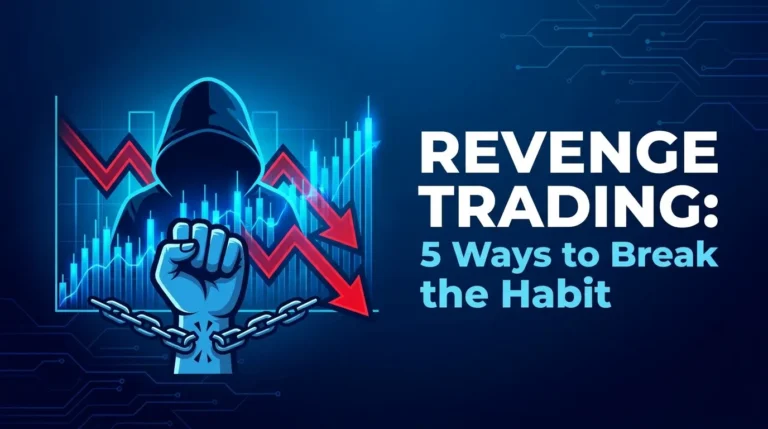
This is the most dangerous stage. The brain wants to close the emotional gap immediately, which often leads to oversized position sizes or entries with no real setup. This pattern has a name in trading psychology circles: revenge trading.
Stage 4: Acceptance or Rationalization
Eventually the emotional charge fades. Traders either accept the loss as part of the process, or they rationalize a bad decision they already made in Stage 3.
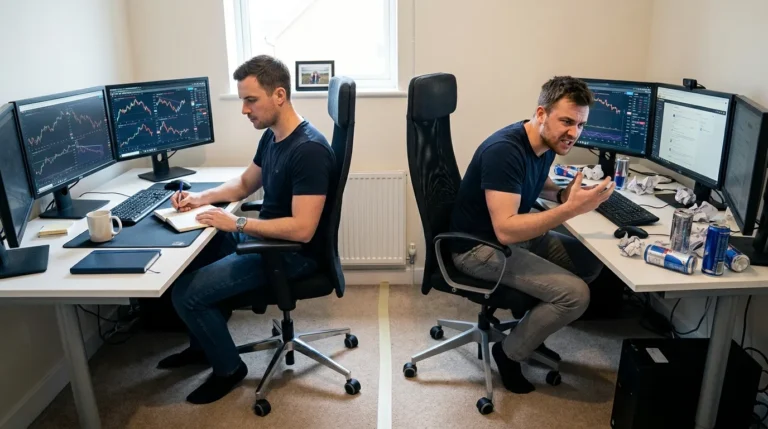
The goal is not to skip these stages entirely. It is to recognize Stage 2 and Stage 3 while they are happening, so you can pause instead of clicking the buy or sell button on impulse.
What to Do in the First Five Minutes After a Loss
This is the window where most account damage either happens or gets prevented. Use these steps as a simple checklist.
Step 1: Step Away From the Screen
Close the chart, or at minimum look away for 60 seconds. This breaks the automatic reach for a new trade.
Step 2: Name What You Are Feeling
Silently or on paper, label the emotion. “I feel angry” or “I feel the urge to win it back.” Labeling an emotion reduces its intensity and pulls you toward logical thinking.
Step 3: Check Your Daily Loss Limit
If you have a rule that caps daily risk (for example, stopping after losing 2 to 3 percent of the account in a day), check where you stand right now before deciding anything else.
Step 4: Write Down the Trade
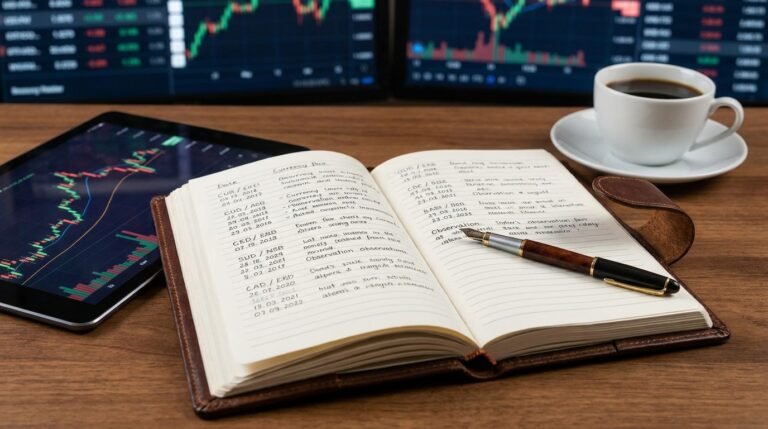
Record the entry, exit, reason for the trade, and how you feel, in a trading journal. This single habit is one of the strongest predictors of long term improvement, because it turns an emotional event into a data point you can review later.
Step 5: Decide With a Rule, Not a Feeling
Ask: “Does my trading plan allow another trade right now?” If the answer is no, the decision is already made for you. This is the entire point of having rules before you are emotional.
What Not to Do After a Losing Trade
Avoiding a few specific behaviors will save most beginners more money than any new strategy will earn them.
- Do not increase your position size to “win it back.” This is the classic revenge trading pattern, and it typically compounds one loss into several.
- Do not move your stop loss further away on an open trade. This turns a planned, bounded loss into an unbounded one.
- Do not jump into a new pair with no setup just to feel active. This is a form of overtrading driven by emotion rather than strategy.
- Do not review your account balance every few minutes. Constant checking keeps the emotional wound fresh and increases impulsive decisions.
- Do not trade to prove something, to yourself or anyone else. The market has no memory of your last trade and does not owe you a recovery.
If any of these patterns feel familiar, it is worth reading a full breakdown of what revenge trading looks like and how to break the habit, as well as the warning signs of overtrading and how it quietly drains accounts.
Reframing Losses as a Normal Cost of Trading
One of the most useful mental shifts a beginner can make is treating losses the way a shop owner treats inventory costs. They are an expected, budgeted part of running the business, not a personal failure.
Professional traders do not aim for zero losses. They aim for a system where wins outweigh losses over a large number of trades, even if individual trades are unpredictable.
A simple way to see this in practice is the breakeven win rate. If your average win is twice the size of your average loss, you only need to win roughly 34 out of every 100 trades to break even, before accounting for any edge at all. That means being wrong most of the time can still be perfectly compatible with a profitable strategy, as long as position sizing and reward to risk stay consistent.
This is exactly why position sizing tools matter more than most beginners expect. Running your numbers through a Risk Calculator before every trade keeps each loss small and pre planned, so a single red trade never threatens your account.
Building a Post Loss Routine That Protects Your Account
A written routine removes the need to make good decisions while emotional, because the decisions are already made in advance.
Consider building a simple post loss checklist:
- Confirm the loss matched your predefined risk per trade.
- Log the trade in your journal, including the emotional state at entry and exit.
- Take a short break, ideally 15 to 30 minutes, away from charts.
- Review whether the setup followed your plan or was discretionary.
- Only return to trading once your daily loss limit and mental state both check out.
Keeping a consistent journal is one of the most repeated recommendations among experienced traders, because it turns a string of emotional moments into a searchable history of what actually works. A full walkthrough of this habit is available in how to keep a forex trading journal properly.
Traders who are actively working on discipline and confidence after a rough stretch may also find it useful to read how to build confidence in forex trading, which covers the mindset side of this same problem.
Using Numbers Instead of Feelings to Recover
The fastest way to remove emotion from a losing trade is to make the next decision entirely mechanical.
Know your maximum drawdown before it happens. Many prop trading firms and experienced traders cap account drawdown at 10 to 15 percent. Tracking this with a Forex Drawdown Calculator shows exactly how much room remains before hitting a hard stop, which takes the guesswork (and panic) out of a losing streak.
Revisit your risk reward ratio. A string of losses can sometimes be a math problem rather than an emotional one. If your reward to risk ratio is too tight, even a solid win rate will not be profitable. The full breakdown is covered in risk reward ratio: the formula traders use to stay profitable.
Confirm your risk per trade is actually appropriate. Many beginners risk far more than they realize until they run the numbers. See how much you should risk per trade for a clear framework.
Double check your stop loss placement. A stop that is placed too tight, based on emotion rather than structure, will get hit constantly and create unnecessary losing streaks. Review how to set a stop loss in forex for a beginner friendly method.
Replacing “I feel like I should trade again” with “here is what my calculator shows” is, in practice, the entire skill of emotional trade management.
When a Losing Streak Means It Is Time to Stop
Not every losing streak is just bad luck. Sometimes it is a signal that something in the plan needs to change.
Consider stepping back completely if any of the following are true:
- You have hit your predefined daily or weekly loss limit.
- You notice you are increasing position size after losses rather than keeping it constant.
- You cannot explain, in one sentence, why your last three trades were taken.
- You feel a physical stress response (racing heart, shallow breathing) before entering trades.
- Your drawdown has crossed the maximum threshold in your trading plan.
In any of these cases, the correct action is to close the platform, not open a new chart. Reviewing risk management strategies for forex beginners is a useful next step before trading again.
FAQ
Is it normal to feel angry or upset after a losing trade?
Yes. Behavioral research consistently shows that losses are processed as more emotionally intense than equivalent gains. Feeling frustrated after a loss is a normal brain response, not a sign that you are unsuited to trading. What matters is how you act on that feeling in the minutes that follow.
How long should I wait before trading again after a loss?
There is no universal number, but many traders use a minimum break of 15 to 30 minutes, combined with a rule that the next trade must meet every criterion in their plan. The break itself matters less than confirming your emotional state and daily loss limit before reentering.
What is the difference between accepting a loss and revenge trading?
Accepting a loss means logging it, reviewing what happened, and waiting for the next valid setup within your plan. Revenge trading means entering a new position, often with a larger size, specifically to recover the loss quickly rather than because a real setup appeared.
Does journaling actually help with the emotional side of trading?
Yes. Writing down the trade details and your emotional state at the time creates a record you can review later without the emotional charge of the moment. Over time, this makes it easier to spot patterns, such as certain times of day or market conditions where emotional trading is more likely.
Should beginners avoid trading after a losing streak entirely?
Not necessarily, but beginners should have a predefined loss limit that triggers a full stop for the day or week. Continuing to trade past that limit, hoping to recover losses, is one of the most common ways beginner accounts are damaged.
Can risk management tools actually reduce emotional trading?
Yes, indirectly. Using a position size or drawdown calculator before every trade means the risk on each trade is already capped and known in advance. This removes a large amount of the uncertainty that fuels emotional decision making after a loss.
Is it possible to be profitable while losing more trades than you win?
Yes. A trading system with a lower win rate can still be profitable if the average winning trade is meaningfully larger than the average losing trade. This is why reward to risk ratio and position sizing matter as much as win rate.
Financial Disclaimer
This article is for educational purposes only and does not constitute financial, investment, or trading advice. Forex trading involves substantial risk of loss, including the potential loss of more than your initial deposit, and is not suitable for all investors. Past performance does not guarantee future results. US retail forex trading is regulated by the Commodity Futures Trading Commission, and leverage on major currency pairs is limited to 50:1 for retail accounts. Always consult a licensed financial advisor before making trading decisions.
Conclusion
A losing trade is not a referendum on your ability as a trader. It is a routine, expected event that every profitable trader experiences regularly, and the CFTC’s own data confirms most retail traders are in the red in any given quarter.
The traders who last are not the ones who never lose. They are the ones who have a fixed, unemotional routine for the five minutes after a loss: step away, name the feeling, check the rules, log the trade, and let numbers rather than emotion decide the next move.
Build that routine before you need it. Start by running your next trade through the Forex Risk Calculator and tracking your account limits with the Forex Drawdown Calculator, so the next losing trade is small, planned, and forgettable rather than the start of a bigger problem.