How Much Money Do You Need to Start Forex Trading?


Most traders ask this question backwards. They want a number, five hundred dollars, two thousand dollars, ten thousand dollars, so they can open an account and get started. But the real question isn’t how much you need to open a position. It’s how much you need to survive being wrong twenty times in a row without blowing up your account or your confidence.
I’ve watched traders fund accounts with $100 and traders fund accounts with $50,000, and the size of the account was never what separated the ones who lasted from the ones who quit within three months. What separated them was whether their position sizing matched their capital. A trader with $300 who understands risk will outlast a trader with $30,000 who doesn’t.
So let’s actually answer this properly, with numbers, not vibes.
The Real Minimum: What Your Broker Lets You Deposit vs. What You Actually Need
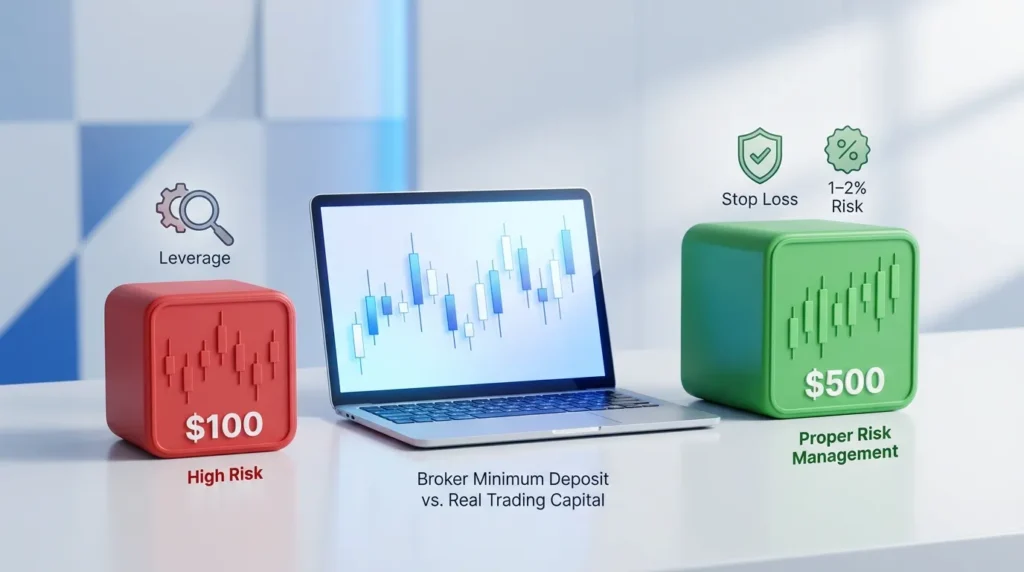
Technically, you can open a live forex account with many brokers for as little as $10 to $100. That’s the marketing number you’ll see everywhere. It’s also close to useless as a planning figure.
The honest answer depends on three things: the pair you trade, the leverage your broker offers, and how much of your account you’re willing to risk per trade. A $100 account trading standard lots with high leverage isn’t undercapitalized, it’s a lottery ticket. A $500 account trading micro lots with disciplined risk can function as a legitimate learning environment.
Here’s a more useful way to frame it. Rather than asking “what’s the minimum deposit,” ask “what account size lets me take a proper stop loss without risking more than 1 to 2% per trade, using position sizes that aren’t so small they round to zero pips of meaningful profit.”
Worked Example: Sizing a Trade on a $500 Account
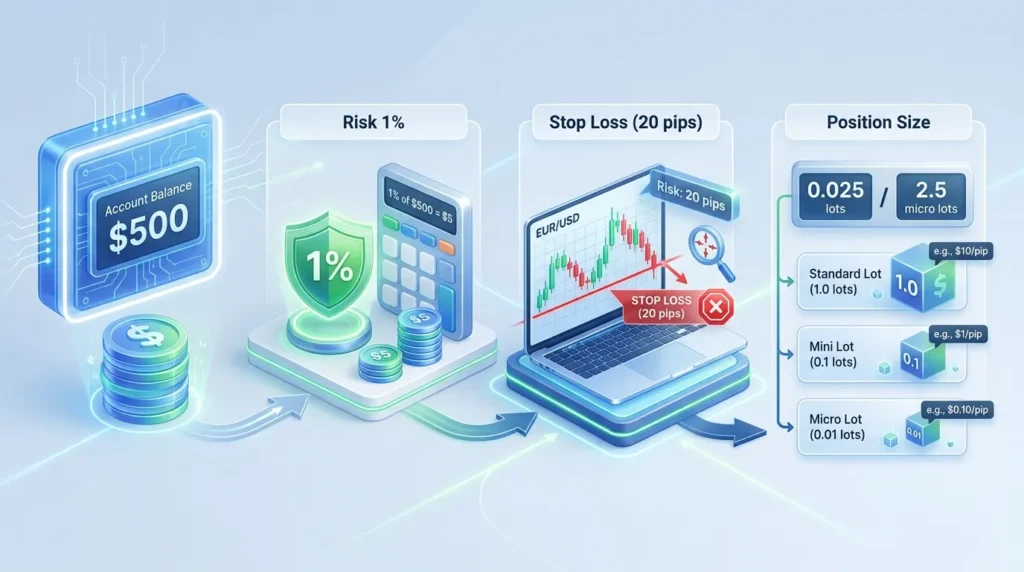
Let’s walk through this with real numbers instead of leaving it abstract.
Say you’re trading EUR/USD on a $500 account, and your rule is to risk 1% per trade, which is $5. Your analysis calls for a stop loss 20 pips away from entry.
For EUR/USD, a standard lot (100,000 units) moves roughly $10 per pip. A mini lot (10,000 units) moves about $1 per pip, and a micro lot (1,000 units) moves about $0.10 per pip.
If your stop is 20 pips and you can only risk $5, you need a position size where 20 pips equals $5. That works out to $0.25 per pip, which means you’d trade roughly 2.5 micro lots (0.025 standard lots).
Most brokers let you size in increments this small. If yours doesn’t, you either widen your account size, tighten your stop, or accept that a $500 account with a 20 pip stop and strict 1% risk needs micro lot precision that not every platform supports cleanly.
This is exactly the kind of calculation that trips people up manually, especially when switching between pairs with different pip values. I built the Forex Risk Calculator on this site specifically for this scenario. Enter your account balance, risk percentage, and stop loss distance, and it returns the position size that keeps your risk consistent, so you’re not eyeballing lot sizes and accidentally risking 4% when you meant to risk 1%.
Comparison: Small Account vs. Larger Account Trade-offs
Neither a small account nor a larger one is objectively “better” to start with. Each comes with a different failure mode.
| Factor | Small Account ($100–$1,000) | Larger Account ($5,000+) |
|---|---|---|
| Risk per trade in real dollars | Low, mistakes are cheap | Higher, mistakes cost more in absolute terms |
| Psychological pressure | Often lower since amounts feel small | Can be higher, real money “feels real” |
| Position sizing flexibility | Limited, may hit minimum lot constraints | More flexible, easier to hit precise risk percentages |
| Temptation to overleverage | Very high, since gains feel small in dollars | Present but usually more disciplined by necessity |
| Suitable for | Learning execution and habits | Testing a proven strategy with meaningful stakes |
In my experience, a small account is genuinely useful for the first three to six months, not because the money matters, but because losing real dollars, even fifty cents at a time, changes your decision making in a way that demo trading never does. Demo accounts don’t create the flinch reflex that live losses do. That said, once you’ve built consistent habits, staying too small for too long can actually slow your progress, because the position sizes may be too tiny to meaningfully test whether your edge holds up under normal market conditions.
What Most Guides Don’t Tell You
Most articles on this topic stop at “start with what you can afford to lose.” That’s true but incomplete, and it skips the parts that actually cause account blowups.
Mistake one: sizing based on lot size instead of risk percentage. New traders often decide “I’ll trade 0.1 lots” as a fixed habit, regardless of stop distance or account balance. That means your risk changes wildly from trade to trade depending on volatility. A fixed percentage risk model, not a fixed lot size, is what keeps your risk consistent as conditions change.
Mistake two: ignoring margin requirements until a margin call happens. Traders calculate position size for risk but forget that leverage also determines how much margin gets locked up per trade. On a small account, several open positions can eat your available margin even while your risk-per-trade math looks fine, leaving you unable to take a new setup or forced into a margin call during a volatile session.
Mistake three: treating “starting small” as an excuse to skip a trading plan. I see this constantly. Traders reason that because the account is small, the stakes are low, so they don’t need defined entry and exit rules. That habit doesn’t magically improve when the account grows. If anything, the habits you build on a small account are the ones that will run your larger account later, for better or worse.
My actual opinion, and I know some traders will disagree: I think most beginners should start with no less than $500, not $100, even though $100 accounts are marketed everywhere. Below that, the math of proper position sizing versus broker lot size increments gets so cramped that you’re forced into either oversized risk or trade sizes so small they teach you nothing about compounding. A $100 account can teach you platform mechanics, but it can’t realistically teach you money management, because there’s not enough room to make mistakes and correct course.
Common Questions Traders Ask After This
Does a bigger account mean bigger profits automatically?
No. Profit is a function of your edge and your risk management applied consistently, not account size alone. A larger account without discipline just means larger, faster losses.
Should I start with a demo account first, and for how long?
Yes, but treat the demo phase as a test of process, not profit. A few weeks is usually enough to confirm you understand your platform and can execute your plan under pressure without account and trade management errors. After that, live trading, even at a small size, teaches lessons demo accounts can’t.
What if my broker’s minimum lot size doesn’t fit my ideal risk calculation?
This happens more than people expect, especially on accounts under $300. In that case, either widen your stop loss slightly and reduce entries to setups with better risk to reward, or accept a slightly larger risk percentage on that specific trade while keeping your overall exposure across open positions in check.
Is it better to risk 1% or 2% per trade on a small account?
There’s no universal answer, but 1% is the more conservative and forgiving starting point while you’re still building consistency. Moving to 2% is reasonable once you have a track record showing your win rate and risk to reward actually support it.
This article is for general education about forex trading mechanics and is not financial advice. Trading forex involves substantial risk of loss and is not suitable for every investor.