How to Build Confidence in Forex Trading


Every new trader hits the same wall. You understand the charts. You know what a pip is. You’ve watched enough videos to explain support and resistance to a friend. But the moment real money is on the line, your hands shake and your plan disappears.
This isn’t a personal flaw. It’s the normal starting point for almost everyone who trades forex.
Confidence in forex trading isn’t something you’re born with. It’s built the same way a pilot builds confidence, through structured practice, small stakes, and repeated exposure to the exact situation that scares you. This guide walks through what actually builds lasting trading confidence, and what only feels like it does.
Why Confidence Feels So Hard to Find in Forex
Confidence problems rarely come from lack of knowledge. Most beginners can explain a strategy perfectly in theory. The gap shows up the moment a live trade starts moving against them and every rule they know suddenly feels optional.
What Trading Confidence Actually Is (and Isn’t)
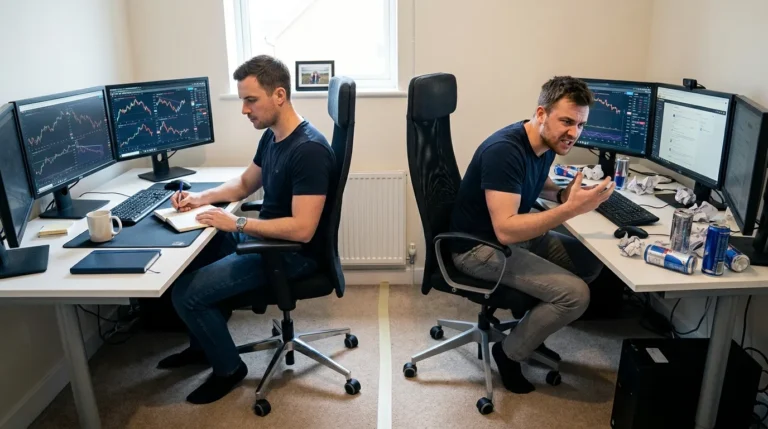
Real trading confidence is the ability to follow your plan under pressure, even when a trade is losing. It’s calm, quiet, and often invisible. Confident traders don’t feel excited before a trade. They feel prepared.
Fake confidence looks different. It shows up as certainty about a specific outcome, a feeling that “this trade can’t lose,” or the urge to size up because you’re on a winning streak. This is closer to overconfidence bias, a well documented pattern where traders overestimate their own skill after a string of wins.
The distinction matters because building the wrong kind of confidence is dangerous. Real confidence protects your capital. False confidence usually destroys it.
The Real Reasons New Traders Feel Shaky
Before fixing the problem, it helps to understand where it comes from. Most beginner confidence issues trace back to one of these:
No real risk plan. If you don’t know exactly how much you can lose before you enter a trade, every price movement feels like a threat.
Trading size that’s too big. A 5% risk per trade turns every candle into an emotional event. A 1% risk per trade rarely does.
No track record to look back on. Confidence is partly evidence based. Without a journal or history of trades, you have nothing to reassure yourself with.
Comparing yourself to unrealistic online examples. Screenshots of huge wins online create a false benchmark that makes normal, steady progress feel like failure.
Random rules instead of a system. If your entries change every day based on how you feel, there’s nothing consistent to trust.
Each of these has a practical fix, covered below.
Build Confidence Through Preparation, Not Motivation
Motivation is unreliable. Preparation isn’t. Traders who feel calm before entering a position usually share one habit: they decided everything about the trade before it happened.
Before every trade, know:
- Your entry price
- Your stop loss price
- Your take profit target
- Your exact position size
If you haven’t calculated these numbers in advance, you’re improvising, and improvising under financial pressure is exactly what erodes confidence. Tools like a Lot Size Calculator or a Forex Risk Calculator remove the guesswork so you enter every trade already knowing your worst case outcome.
Confidence grows when the outcome of a losing trade is already priced into your expectations. It shouldn’t feel like a surprise.
Start With a Demo Account, But Use It Correctly
Demo accounts get criticized for not teaching real emotional discipline, and that criticism is partly fair. Trading with money you can’t actually lose doesn’t replicate the pressure of a live account.
But demo trading still has a place in building confidence, if you use it for the right purpose: mechanical repetition. Use a demo account to practice the physical process of placing a trade, setting a stop loss, and calculating your position size correctly until it feels automatic.
Once the mechanics are second nature, move to a small live account. Confidence under real pressure can only be built with real, even if small, stakes.
Risk Small Enough That Losses Don’t Shake You
This is the single biggest confidence lever available to any trader, and it’s the one most beginners ignore.
If losing a trade makes your stomach drop, your risk per trade is too large for your current experience level. Most professional traders risk between 1% and 2% of their account per trade, and beginners are generally better off starting closer to 1% while they build a track record.
Here’s a simple example. On a $2,000 account risking 1% per trade, a loss costs $20. That’s uncomfortable, but survivable, and repeatable. The same account risking 5% per trade loses $100 on the same setup, an amount large enough to trigger fear, hesitation, and eventually the kind of impulsive decisions covered in our guide on overtrading in forex.
Confidence isn’t built by avoiding losses. It’s built by making losses small enough that they don’t change your behavior.
Keep a Trading Journal to See Your Own Progress
Confidence needs evidence, and a trading journal is the most direct evidence you can build. Without one, every losing streak feels like proof you’re bad at this. With one, you can look back and see the actual pattern: how often you followed your rules, how your win rate trends over time, and whether your risk-to-reward ratio is actually holding up.
At minimum, log for every trade:
| Field | Why It Matters |
|---|---|
| Entry and exit price | Confirms you followed your plan |
| Position size | Confirms your risk stayed consistent |
| Reason for entry | Reveals whether you’re trading a system or a feeling |
| Outcome and pips gained/lost | Builds a real performance record |
| Emotional state | Flags patterns like fear or revenge trading |
After 30 to 50 logged trades, most traders can see clear patterns emerge. That data becomes the foundation of real, evidence based confidence, rather than confidence based on a feeling.
Build a Rule-Based System You Can Trust
Confidence collapses fastest when a trader doesn’t have consistent rules. If your entry criteria changes daily, there’s nothing stable to trust when a trade goes against you.
A basic rule-based system needs, at minimum:
- A specific setup you look for before entering
- A maximum risk per trade, calculated in advance
- A stop loss placed based on chart structure, not emotion
- A predefined take profit level or exit rule
It doesn’t need to be complicated. Simple, well-tested rules that you actually follow build far more confidence than a complex strategy you abandon under pressure.
Learn to Separate Confidence From Overconfidence
This is the section most guides skip, but it may be the most important one for long-term survival.
Behavioral finance research consistently shows that traders become overconfident after a series of wins, taking on larger positions and skipping their normal analysis because recent success feels like proof of skill. This pattern shows up across financial markets, not just forex, and it’s one of the most reliable predictors of a large drawdown.
Ask yourself these questions after a winning streak:
- Am I still calculating my position size the same way?
- Am I still using the same stop loss discipline?
- Would I take this exact trade if I’d lost the last three, instead of won them?
If the honest answer to any of these is no, that’s a signal you’re drifting from real confidence into overconfidence. A Drawdown Calculator can help you see, in concrete numbers, how quickly overconfident position sizing can erode an account.
What to Do After a Losing Streak
Losing streaks are where confidence is either rebuilt or permanently damaged, depending on how you respond.
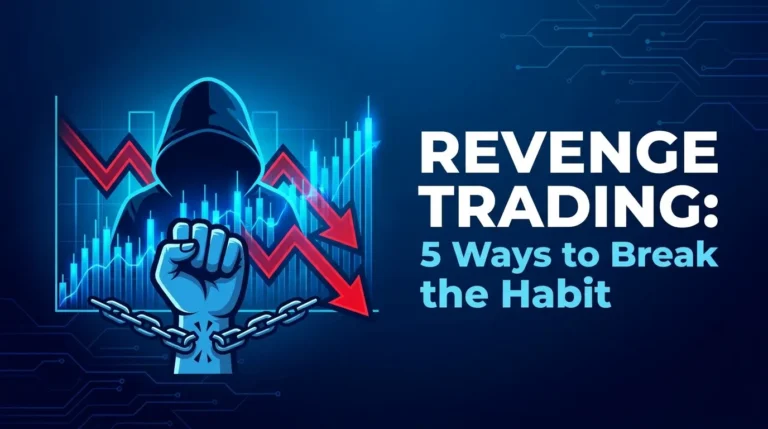
The wrong response is trying to win it back immediately, increasing size, or abandoning your rules to “make something happen.” This pattern is well known enough to have its own name in trading psychology, and it rarely ends well.
The better response:
- Reduce size, don’t increase it. Cutting risk after a losing streak protects your capital while you diagnose what went wrong.
- Review your journal, not your feelings. Look for whether your rules were actually followed. If they were, the losses may simply be normal variance, not a system failure.
- Take a short break if needed. Stepping away for a day resets your emotional state before it starts influencing your next entries.
- Return at your normal size only once you’ve followed your rules consistently again.
Confidence after a drawdown comes back through discipline, not through a big recovery trade.
Realistic Timeline: How Long Confidence Takes to Build
There’s no universal number, but most traders who stick with a structured process describe a similar rough pattern: the first few months feel shaky and reactive, the next several months involve slowly trusting a tested system, and real, stable confidence tends to arrive only after a trader has lived through both a winning stretch and a losing stretch without abandoning their rules.
Trying to shortcut this timeline with bigger position sizes or more aggressive strategies almost always backfires. Confidence built quickly through luck tends to disappear the moment the market changes, while confidence built slowly through consistent risk management tends to hold.
FAQ
Is trading confidence the same as being right about the market?
No. Confidence is about executing your plan consistently, regardless of whether an individual trade wins or loses. Traders can be confident and still lose a trade, because they know a loss inside their risk limits is an expected, manageable part of the process, not a failure.
How much should a beginner risk per trade while building confidence?
Many educators suggest 1% of account capital per trade as a starting point, since a loss at that size is unlikely to trigger the fear or frustration that leads to abandoning a plan. This is educational guidance, not personalized financial advice, and every trader’s risk tolerance is different.
Can a demo account actually build real trading confidence?
Partially. Demo accounts are useful for practicing mechanics like order entry and position sizing until they’re automatic. They can’t fully replicate the emotional pressure of real money, so most traders still need a small live account to build genuine, pressure-tested confidence.
What’s the difference between confidence and overconfidence in forex?
Confidence looks the same in a winning trade and a losing trade, because it’s based on following a tested process. Overconfidence changes with recent results, showing up as larger position sizes or skipped analysis after a winning streak, and it’s one of the more common paths to a large drawdown.
Why do I feel confident on a demo account but anxious with real money?
This is extremely common and comes down to loss aversion, a well documented psychological pattern where losses feel meaningfully more painful than equivalent gains. Real money activates that response in a way simulated trading doesn’t, which is why gradually scaling into small live positions works better than jumping straight from demo to full size.
Does a trading journal really help with confidence, or is it just busywork?
A journal gives you an objective record instead of relying on memory or emotion. Traders often remember their losses more vividly than their wins, which distorts self-perception. A journal corrects that by showing the actual pattern of your results over time.
Is it normal to lose confidence after a losing streak?
Yes, and it happens to experienced traders too. What separates a temporary dip from a lasting problem is the response. Reducing size, reviewing your journal, and returning to your rules tends to rebuild confidence faster than trying to force a big recovery trade.
Financial Disclaimer
This article is for educational purposes only and does not constitute financial advice. Forex trading involves substantial risk of loss and is not suitable for all investors. Under CFTC and NFA regulations, retail forex leverage in the United States is capped at 50:1 for major currency pairs and 20:1 for all other pairs. Always assess your own risk tolerance and consult a licensed financial professional before making trading decisions.